IEP Meeting Checklist for Teachers (Before, During, and After)
The follow-up phase is where most IEPs fall apart. Here is how to get it right.
I've been in IEP meetings where nobody was quite sure what the classroom data actually showed. Not because teachers didn't care, but because nobody had told them what to bring, what to track, or what their role at the table actually was. The specialists had their reports. The parents had their questions. The general ed teacher had their impressions and hoped that would be enough.
It usually isn't. This checklist is what changes that.
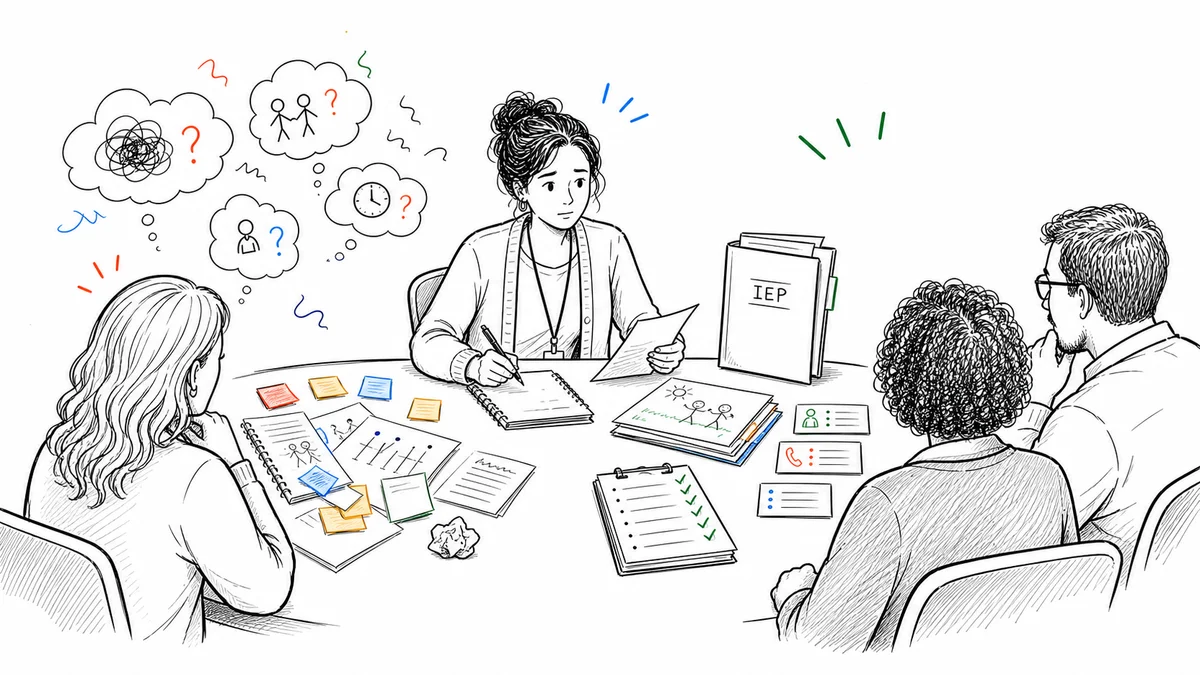
This iep meeting checklist for teachers breaks down exactly what you need to do before you walk into the room, what to track while you are sitting at the table, and what to do when the meeting is over. We are going to focus heavily on the "after" phase. This follow up stage is where most teachers drop the ball, yet it is the most critical part of the entire process.
Phase 1: Before the Meeting (Preparation)
Preparation is everything. Do not wait until the morning of the meeting to start gathering your thoughts. Scrambling at the last minute makes you look unprofessional and guarantees you will forget something important.
Gather Your Concrete Data
You need hard evidence of the student's performance. Pull recent work samples, benchmark assessment scores, and any behavioral logs you keep. Anecdotes are helpful for context, but numbers and physical examples are undeniable. If a student is struggling with reading comprehension, bring three specific examples of recent assignments where they clearly fell short of the standard.
For many general education teachers, IEP prep is also when the documentation gap becomes obvious. You have been observing the student all year. But the record of what you actually saw lives across sticky notes, a few scattered emails, and your own memory. If that is where you are, focus on what you can reconstruct: two or three specific examples with approximate dates, a rough sense of how often the behavior occurs, and any parent contacts you can verify. That is still useful data. For future meetings, capturing observations in real time makes this phase much easier. Even a short note logged the same day as an incident gives you something concrete to bring to the table instead of relying on recall from months ago. A simple log in a tool like ShortHand can serve as a scratchpad before you enter anything into your school's official systems. See The Only Teacher Documentation Log Template You Actually Need for a practical starting point.
If you've been logging observations in ShortHand throughout the term, Ask ShortHand can help you quickly find out something like, "what have I noted about transitions this quarter?" before you walk in, instead of scrolling back through every entry the night before. It only answers from notes you've actually written, not from the IEP goals themselves, so it's a way to review your own documentation quickly, not a substitute for reading the student's plan.
Review the Current IEP Thoroughly
Read the student's current goals before the meeting. Are they actually meeting them in your classroom? Be ready to speak directly to their progress or lack thereof. Make specific notes on their accommodations. Are there accommodations listed that the student never uses or refuses to use? Are there new accommodations you believe they desperately need to be successful?
Prepare Your Key Talking Points
Jot down a few concise bullet points. Always start with a positive observation. Have a genuine strength to share right out of the gate. Then, outline your main academic or behavioral concerns. If you need help phrasing these concerns without sounding negative, check out our guide on what to say at an IEP meeting. Keep your points brief, factual, and focused on solutions.
Phase 2: During the Meeting (Participation)
When the meeting officially starts, your primary role is to provide a clear, objective picture of the student's daily reality in your specific classroom.
Listen First and Take Notes
Let the parents and the special education case manager speak first. Take active notes on their concerns. Very often, parents will bring up issues happening at home that perfectly explain the confusing behaviors you are seeing in class. Listening builds trust and gives you crucial context.
Share Your Data Objectively
When it is your turn to speak, stick strictly to the facts. Instead of saying a student is lazy, state clearly that they have completed exactly two out of ten homework assignments this quarter. Present the physical work samples you gathered. Say what you observed. Let the data do the persuading.
Track the Action Items
Do not rely on your memory. IEP meetings are long and filled with dense information. Write down any specific agreements made during the meeting. If the team decides to try a new behavior chart, note it. If the parent agrees to check an assignment notebook every single night, write that down immediately. You will need these specific details later.
Phase 3: After the Meeting (Follow Up)
This is the phase almost everyone skips. You walk out of the conference room, exhale deeply, and rush to your next class. But the work is not completely done. Without follow up, the best IEP meeting falls apart.
Review and Organize Your Notes
Take exactly five minutes at the end of the school day to review what you wrote down. Clean up your messy handwriting while the conversation is still fresh in your mind. If you need a reliable format for this, grab our IEP meeting notes template. Clear, organized notes keep everyone aligned and ensure the student gets exactly what was promised.
Implement the Changes Immediately
If the IEP team agreed on new accommodations, put them into practice the very next day. Do not wait for the finalized paperwork to hit your desk two weeks later. If you need to move a student's seat to the front row or provide a graphic organizer for the upcoming test, do it immediately.
Follow Up With the Parents
This final step is absolutely critical for building a long term partnership. Send a quick, professional message to the parents thanking them for their time and explicitly reiterating the agreed upon next steps. Remind them what you are doing on your end, and gently remind them of what they agreed to do at home.
This is where having the right communication tool makes a massive difference in your workload. Instead of digging through a cluttered email inbox or trying to catch busy parents on the phone during your prep period, use ShortHand. You can log your private follow up notes and send a quick, documented message directly to the parents in under a minute. ShortHand keeps a permanent, timestamped record of the communication. It keeps everyone on the same page and ensures the agreed upon plan is actually executed.
Treat the follow up phase with the exact same importance as your initial preparation. Keep this checklist handy for your next meeting, and watch how much more effective your parent partnerships become.
Part of The Teacher's Complete Guide to Parent Communication.
Frequently Asked Questions
Stop trying to remember everything.
Try ShortHand Free →