Moving Beyond the Friday Reporting Grind
What changed when I stopped saving everything for the end of the week
It's 4:00 PM on a Friday. The building is mostly empty, the janitor's cart is rattling down the hall, and I'm still at my desk. I have a stack of math tests to grade, but instead I'm staring at a blank email draft.
I need to send a behavior update to a parent who, understandably, wants to know how their child did this week. And once I'm done with that email, I have four more to go.
The problem isn't the parent asking. The problem is the process. To give an honest, detailed update, I have to mentally reconstruct five days of a chaotic 3rd-grade classroom. I'm digging through scribbled sticky notes and trying to remember the specific wins and struggles from Tuesday morning. It's harder than it sounds.
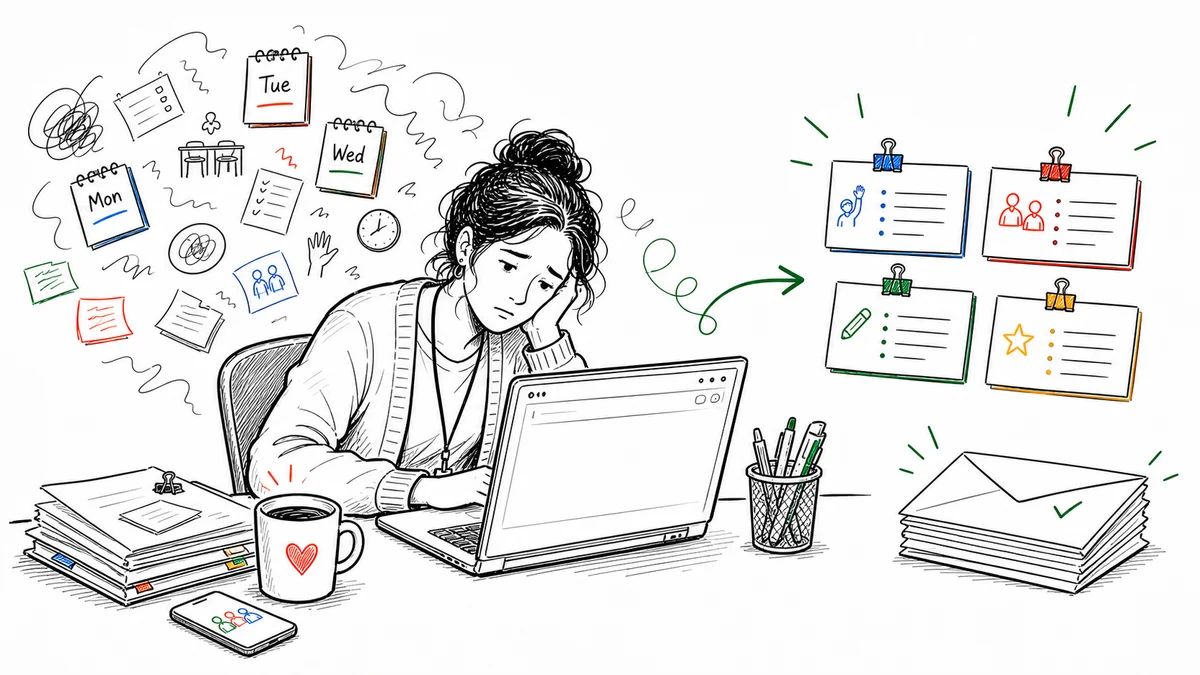
The Weight of a Blank Screen
Most people love Fridays. I was starting to dread them.
I'm always excited to get home and spend the weekend with my daughter. But the weight of not trusting my own memory would take over the drive home. Was the week actually good for this student? Was the behavior on Thursday an outlier or a pattern? Is this report going to make sense to the parent, or am I piecing it together from a memory that's already unreliable?
These are the questions that keep teachers up at night. When you don't have the data, you're guessing. And the stakes for these kids are too high for guesswork.
One Friday I was still at my desk at 5:00 PM. My daughter was calling. I had two more emails to write and my head was spinning. Something needed to change.
The Gap Between Tracking and Telling
As a teacher and a former Registered Behavior Technician, I've been trained to track behavior precisely. The irony is that none of the tools I was given made it easy to actually do that in a real classroom.
Most apps and systems are designed for the tracking part: the quick logging of a behavior in the heat of the moment. But they fall short on the telling part. Converting raw logs into a professional, helpful narrative for a family takes time that teachers simply don't have.
When I'm in the middle of a math or science lesson, I can't stop to write a paragraph. But if I don't capture something right then, it's gone. That gap, between the moment it happens and the moment you report it, is where the stress lives.
And that gap gets wider on Fridays. By the end of the week, Monday might as well have been a month ago.
Why Saving It All for Friday Never Works
The Friday reporting grind is what happens when documentation and communication are treated as separate tasks that both get pushed to the end of the week.
When you save everything for Friday, a few things happen. The details fade. The notes you do have are incomplete. You spend more time reconstructing than reporting. The emails you send are vague because vague is all you have left. And then you drive home feeling like you let some families down, not because you didn't care, but because the system set you up to fail.
The alternative isn't working harder. It's closing the gap between when something happens and when you record it.
What Actually Changes When You Log in the Moment
The first time I logged a behavior note while walking between desks during a lesson, just a quick voice note, done in about four seconds, I realized how much I had been losing by waiting.
The specific detail is there. The context is there: what subject, what time, what triggered it, what happened next. And because I captured it in the moment, there's no reconstruction involved on Friday. I'm reviewing something that already happened instead of trying to remember whether it happened.
Over time, patterns become visible without any extra work. I can look at a student's log and see that the difficult moments cluster on Monday mornings and Thursday afternoons. I can see that the behavior got better after I changed his seat in February. That's not something I could have told you from memory. That's data.
Automating the Narrative
I built ShortHand because I needed a bridge between the moment something happens and the parent communication that needs to follow.
Instead of starting from a blank page every Friday, ShortHand uses AI to draft progress reports and parent messages based on the actual notes I logged throughout the week. I tap a few buttons, the app takes my notes, and a draft appears. It's not a template with blanks to fill in. It's a narrative built from my real observations.
Sometimes the initial tone is a little off, and I give it a quick direction: "make this sound more encouraging" or "focus more on the social goals." In seconds, it's adjusted. Half the time, the draft reminds me of a positive moment from earlier in the week that I had completely forgotten about by Friday.
Last week it reminded me that Joey had been kind to a student with special needs during lunch. His mom was so happy to hear that she cried. That moment would have been invisible under the old system.
Reclaiming Your Afternoons
Teaching is demanding enough without also being a full-time ghostwriter for thirty different families. We need tools that work at the speed of a real classroom and handle the administrative work automatically.
Now I leave on time on Fridays. The emails go out earlier in the week, when the details are still fresh and the communication is more specific. Parents get better information. I feel more on top of things. Nobody's weekend gets ruined by a vague, half-remembered update that I wasn't confident sending.
If you're tired of the Friday reporting marathon, try ShortHand for free and see if it changes your Fridays the way it changed mine.
Gregory Lebed is a 3rd grade teacher with 20+ years in education and a former Registered Behavior Technician (RBT).
Part of The Teacher's Survival Guide to Workload and Burnout.
Stop trying to remember everything.
Try ShortHand Free →