120+ Report Card Comments for Behavior (Copy and Paste, by Situation)
Stop staring at a blank cursor. Here are the behavior comments that actually hold up.
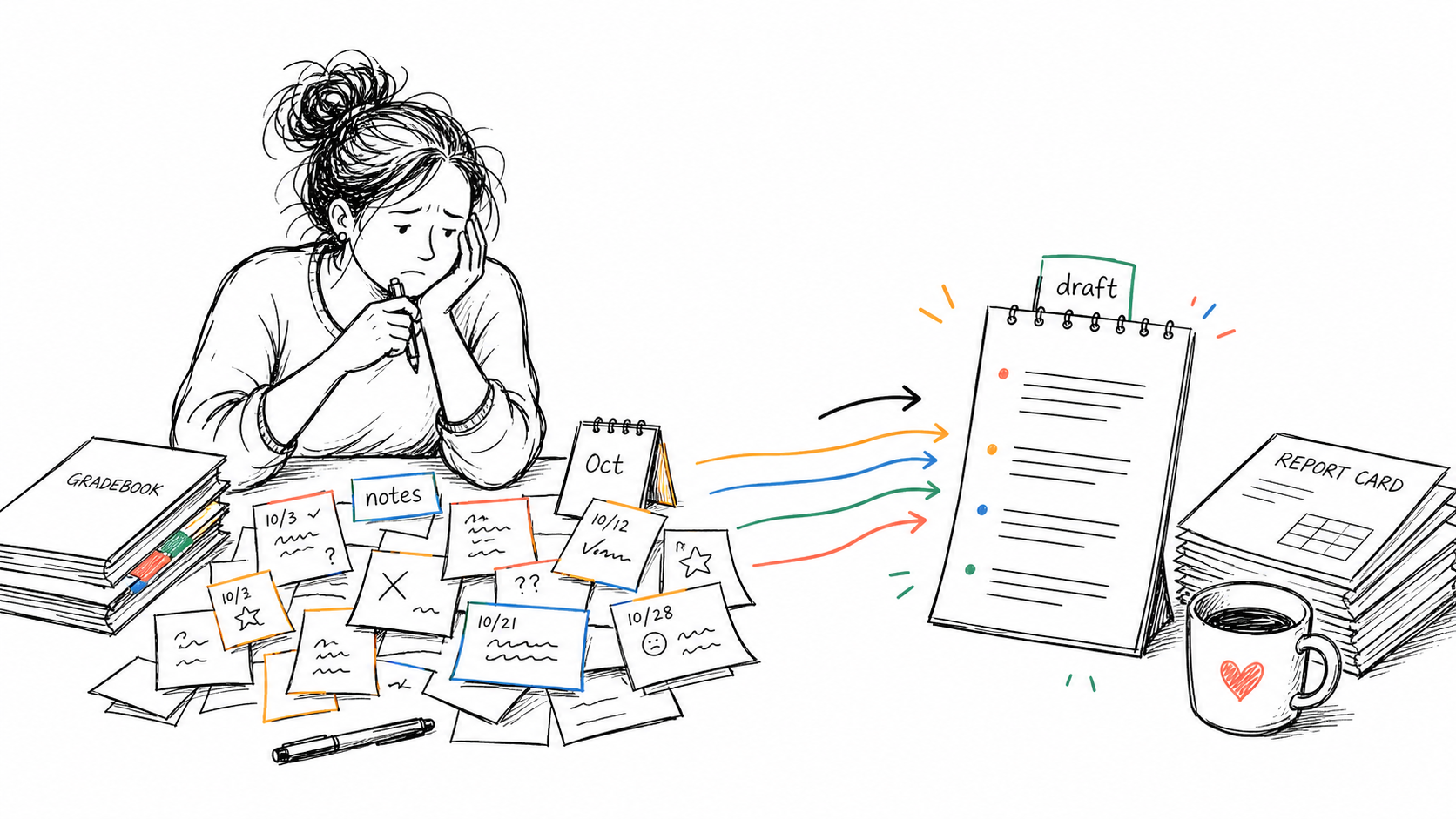
It's report card season. You have 25 students, a stack of notes that made perfect sense in October and now mean nothing, and a blinking cursor waiting for something that doesn't sound like it was written by a legal department.
I've been there. Every teacher has.
The hardest report card comments to write are always the behavior ones. Academic progress is relatively easy to describe. But behavior? You're trying to be honest without being harsh, specific without singling a kid out, and professional without losing the parent in EdSpeak.
As both a teacher and a parent of a neurodiverse child, I've seen these comments from both sides. I've written them at the end of a long school day, and I've read them wondering what they actually meant for my own child. That's one reason I've become so careful about the language I use. A good behavior comment should help a family understand what is happening and what support looks like moving forward, not leave them feeling judged.
Behavior is communication, not a character flaw
As a former Registered Behavior Technician, I know firsthand that behavior is communication, not a fixed personality trait. As a parent, I've seen how powerful that distinction can be. A comment that describes a behavior feels solvable. A comment that sounds like a judgment about who a child is can stay with a family long after the report card is filed away.
We also worry, often without naming it, about setting a permanent label on a child. When we are exhausted at the end of a long grading period, finding the mental bandwidth to write constructive behavior comments feels almost impossible. So we water down our words, which helps nobody. The formula below is how I get past that.
Here's what I've learned from years in the classroom and from reading report cards as a parent: the best behavior comments are short, factual, and forward-looking. They tell the family what you see, not what you feel. They focus on observable behaviors, explain the support being provided, and leave room for growth.
Below are 120+ examples organized by situation. Copy them, adapt them, make them yours.
For the social-emotional learning section of the report, we have a dedicated set of social emotional report card comments, and for kids who are behind academically there are positive comments for struggling students. Otherwise, start with the sections below.
Jump to a section:
- Behavior is communication, not a character flaw
- When behavior is strong
- When behavior is improving
- When there are ongoing concerns
- For students with behavior problems
- For impulsivity and self-regulation
- For attention and focus
- For social interactions and peer relationships
- For students with IEPs or behavior plans
- Rules I follow
- The comment that landed me in the principal's office
When behavior is strong
- "[Name] consistently demonstrates respect for classmates and contributes positively to our classroom community."
- "[Name] is a natural leader who models expected behavior for peers."
- "[Name] has shown remarkable growth in managing frustration this term. I'm proud of the progress."
- "[Name] follows classroom expectations independently and rarely requires reminders."
- "[Name]'s positive attitude is contagious. It's a pleasure to have them in class."
- "[Name] demonstrates self-control and maturity beyond their years."
- "[Name] takes responsibility for their actions and handles feedback gracefully."
- "[Name] is kind, thoughtful, and consistently treats others with respect."
- "[Name] sets a great example for their peers through their behavior and attitude."
- "[Name] arrives ready to learn and maintains that focus throughout the day."
When behavior is improving
- "[Name] has made meaningful progress in [area] this term. With continued effort, I expect to see further growth."
- "[Name] is working hard to manage [specific challenge]. The improvement since [month] has been noticeable."
- "[Name] responds well to redirection and is developing stronger self-regulation skills."
- "This has been a growth term for [Name] in the area of [behavior]. We are proud of the steps forward."
- "[Name] is building the habits and routines that support their success in the classroom."
- "With support, [Name] is learning to [specific skill]. We will continue to build on this progress next term."
- "[Name] has put in real effort this term. That effort is showing."
- "I have seen real growth in [Name]'s ability to [behavior]. We are heading in the right direction."
- "[Name] is more consistent than they were in September. The work they're putting in is paying off."
- "[Name] has surprised me in the best way this term. Keep it going."
These 120+ examples cover behavior specifically. The Report Card Comment Library is built to get you to the right comment in seconds instead of scrolling a long list. Search every comment by keyword, or filter by section, category, tone, and grade band to quickly find one that fits the student you’re writing about.
Type the student’s name once and it drops into every comment. Copy the one that fits, then move to the next student.
374 comments, organized by section and category. One-time $4.99, no subscription.
When there are ongoing concerns (honest but constructive)
- "[Name] continues to work on [behavior]. We are collaborating on strategies to support continued growth."
- "[Name] benefits from frequent check-ins and reminders to stay on task. This is an area of focus going forward."
- "[Name] is developing the skills to manage [challenge] independently. Additional support at home would be beneficial."
- "We are working together with [Name] to address [behavior]. I appreciate the family's partnership in this process."
- "[Name] has difficulty with [specific situation] and is receiving additional support to build these skills."
- "[Name] is working on making choices that support their learning and the learning of those around them."
- "There have been some challenges this term around [behavior]. I'd welcome a conversation to align our approaches."
- "[Name] sometimes struggles to [behavior]. We are using [strategy] to support them and will continue to monitor progress."
- "[Name] is working on [behavior] and I am committed to supporting them. Family reinforcement at home goes a long way."
- "This term has had some bumps. I believe [Name] has the ability to turn it around and I am here to help."
For students with behavior problems
These are the hardest comments to write. You have a student with real, ongoing behavior concerns and you need to say something honest without it reading like a referral or a verdict. The key is to describe what you observe, name the support in place, and leave the door open.
- "[Name] has experienced some significant behavioral challenges this term. We are working closely together to support their growth and build the skills they need."
- "[Name] is receiving additional support to address ongoing behavior concerns. Progress is being made and we will continue to monitor closely."
- "[Name] has had a difficult term in terms of behavior. We have strategies in place and I remain committed to helping them succeed."
- "[Name] continues to struggle with [specific behavior]. We are addressing this with consistent supports and appreciate the family's partnership."
- "Behavior has been a significant area of focus for [Name] this term. With continued effort and support, I believe they can make meaningful progress."
- "[Name] has had challenges that have impacted their learning and the learning of those around them. We are working together to address this."
- "[Name] is working through some behavioral difficulties. I am in regular contact with the family and we are aligned on next steps."
- "[Name] benefits from a high level of structure and support. We are continuing to refine our approach to help them be successful."
- "This has been a challenging term for [Name] behaviorally. I am committed to supporting them and will be reaching out to discuss a plan going forward."
- "There have been repeated incidents this term involving [behavior]. We are taking this seriously and working with [Name] and their family on a path forward."
A note on documenting these comments: If you are writing something this direct, make sure you have the logs to back it up. Parent pushback on a tough comment is much easier to handle when you have dated notes, not just a memory. See How to Document Student Behavior as a Teacher or the complete guide to documenting student behavior for the system that makes this sustainable. That is exactly the situation that led me to build ShortHand.
For impulsivity and self-regulation
- "[Name] is working on thinking before acting. We are using [strategy] to support this goal."
- "[Name] has a lot of energy and enthusiasm. We are channeling this into positive classroom participation."
- "[Name] is developing strategies to pause and self-regulate when frustrated."
- "Impulsivity is an area of focus for [Name] this term. We are making progress with consistent support."
- "[Name] is learning to recognize when they need a moment to reset, and that awareness is growing."
- "[Name] responds well when given a quiet space to collect themselves. We are building on that."
- "Self-regulation is something [Name] is actively working on. Progress is slow but real."
- "[Name] is starting to catch themselves before reacting. That is a big step."
For attention and focus
- "[Name] works best in a structured environment with clear expectations and frequent check-ins."
- "[Name] has difficulty sustaining focus during independent work. We are exploring supports to help with this."
- "[Name] benefits from movement breaks and hands-on tasks to stay engaged."
- "[Name] is working on completing tasks independently. Encouragement and routine at home makes a big difference."
- "Focus continues to be a challenge for [Name], particularly during longer work periods. We are addressing this together."
- "[Name] does their best work in small groups or one-on-one settings. We are working on building stamina for independent tasks."
- "Keeping [Name] on task requires more support than average. We are trying several strategies and will continue to adjust."
- "[Name] is easily pulled off course but returns to work quickly with a reminder. Building that independence is the goal."
For social interactions and peer relationships
- "[Name] is learning to navigate peer relationships with greater confidence."
- "[Name] is working on conflict resolution skills and responding calmly in social situations."
- "[Name] benefits from adult support during unstructured times such as recess and transitions."
- "[Name] is developing the social skills that will serve them well throughout their school career."
- "Peer interactions are an area of growth for [Name] this term. We are working on strategies together."
- "[Name] does well one-on-one and is building the skills to apply that in group settings."
- "Unstructured time is challenging for [Name]. We are working on giving them tools to navigate it more independently."
- "[Name] is kind to adults and is working on extending that same patience to classmates."
For students with IEPs or behavior plans
Keep these factual and neutral. Stick to what's observable and documented.
- "[Name] is working toward their behavior goals and has shown progress in [specific area]."
- "[Name] continues to receive support in [area] and is making gains with consistent implementation of their plan."
- "With the supports in place, [Name] is making progress. We will continue to monitor and adjust as needed."
- "[Name]'s plan is in place and we are seeing [specific result]. We will review at the next meeting."
- "[Name] engages well with the strategies in their plan. Consistency across settings is the key next step."
- "Documentation of [Name]'s progress is ongoing. I look forward to discussing this with the team at our next meeting."
A few rules I follow when writing behavior comments
1. Never use language you wouldn't say to the parent's face. If you'd feel awkward saying it at a conference, rewrite it.
2. Be specific about the behavior, not the kid. "Has difficulty staying on task" beats "is easily distracted." One describes a behavior. The other describes a person.
3. Always end with something forward-looking. Even a tough comment lands better with "we are working on strategies to support this" at the end.
4. Keep your notes. If you're writing a comment about a behavior pattern, make sure you have the observations to back it up. That's where a lot of teachers get caught: writing a comment about something they observed but never documented.
That last point is what pushed me to build ShortHand. I was writing report card comments from memory, trying to reconstruct months of behavior from sticky notes and a gut feeling. Now I log notes in real time (a few seconds per student), and when report card season hits, I have actual data to write from instead of guessing.
It makes these comments faster to write, more specific, and a lot easier to defend if a parent pushes back.
The comment that landed me in the principal's office
A few years into my teaching career, I wrote a report card comment that felt beautifully, wonderfully honest. I wrote that a certain student was a constant social disruption who prioritized his friends over his math worksheets. By Tuesday morning, I was sitting in the principal's office with an incredibly angry parent who felt I was personally targeting her child. That was the day I learned that while honesty is essential, the way we package that honesty is what keeps us from spending our prep periods in administrative meetings.
When a teacher writes, "He has a bad attitude in class," the parent does not hear that their child is struggling with task aversion. They hear that the teacher dislikes their kid. Blunt language creates an emotional wall, and the second a parent becomes defensive, you have lost any chance of partnering with them to fix the actual issue.
There are certain words that act like giant red flags for parents and administrators. If you want to avoid triggering a defensive phone call, swap out character judgments for objective descriptions:
| Stop saying this | Start saying this |
|---|---|
| "He is disrespectful to peers." | "He is working on using kind words with classmates." |
| "She refuses to do her work." | "She requires multiple prompts to begin independent tasks." |
| "He is constantly out of his seat." | "He is learning to remain seated during instructional time." |
| "She has a bad attitude." | "She is developing strategies to handle frustration appropriately." |
| "He is too aggressive." | "He is working on keeping safe hands during recess." |
| "She is disruptive during lessons." | "She is practicing quiet listening when others are speaking." |
Professional does not mean dishonest. Changing your phrasing from blunt to professional just means you are acting as the clinical expert in the room. By framing behavior as an objective skill that needs to be learned rather than a character flaw, you reduce defensiveness from families and actually help the student move forward.
The bottom line
Good behavior comments are honest, specific, and constructive. Use the examples above as a starting point, but adapt them to the real kid in front of you. Parents can tell when a comment was written for their child versus pulled from a template.
If you want to make next term's report cards easier, start logging behavior notes now. Even one sentence per student per week adds up to something you can actually use.
Frequently asked questions about behavior report card comments
What should I write for behavior on a report card? Focus on what you can observe and document. Describe the behavior pattern, not the child's character. Be honest about concerns, name any supports in place, and end with something forward-looking. Avoid vague phrases like "needs improvement" with nothing behind them.
How do you write a positive behavior comment? Be specific about what the student actually does well. "Models expected behavior for peers" and "handles redirection gracefully" are more useful to a parent than "has great behavior." Specific observations also hold up better if a parent ever questions them.
How do you write a behavior comment for a difficult student? Describe the behavior, not the child. "Has difficulty staying on task during independent work" is accurate and professional. "Is difficult" is not. Always include what is being done to support the student and invite the family into the conversation.
What are good behavior comments for report cards? Good behavior comments are short, specific, and constructive. They describe something observable, acknowledge where the student is in their development, and point toward what comes next. The examples in this post are a starting point, but the best comments are always adapted to the real student in front of you.
Can I use AI to write report card behavior comments? Yes. The free report card comment generator on this site lets you pick strengths, areas for growth, and behavior observations from a list and generates a polished comment in seconds. No sign-up required. For comments grounded in your actual classroom notes throughout the year, ShortHand does the same thing with your real logged data.
ShortHand is a free classroom app that lets teachers log student behavior notes in under 5 seconds, by voice or text. When report card time comes, your notes are already there. Try it free. · Or use the free report card comment generator to draft comments in seconds.
Frequently Asked Questions
Stop trying to remember everything.
Try ShortHand Free →