The Behavior Intervention Plan Template That Actually Works
It usually happens on a Tuesday morning. The school psychologist or special education coordinator walks into your classroom. They hand you a heavy, stapled packet of paper. They tell you that a student in your third-period class now has an official Behavior Intervention Plan. You are expected to read it, understand it, and implement it immediately.
You nod and smile, but inside, you feel a familiar wave of exhaustion. You already have twenty-eight other students. You already have three distinct lesson plans to deliver. Now you are being asked to memorize specific triggers, replacement behaviors, and data collection protocols for one highly disruptive student.
When you sit down to look at the paperwork, it feels overwhelming. It is filled with clinical jargon and theoretical strategies that seem completely divorced from the reality of a loud, chaotic classroom. You are a general education teacher, not a behavior analyst.
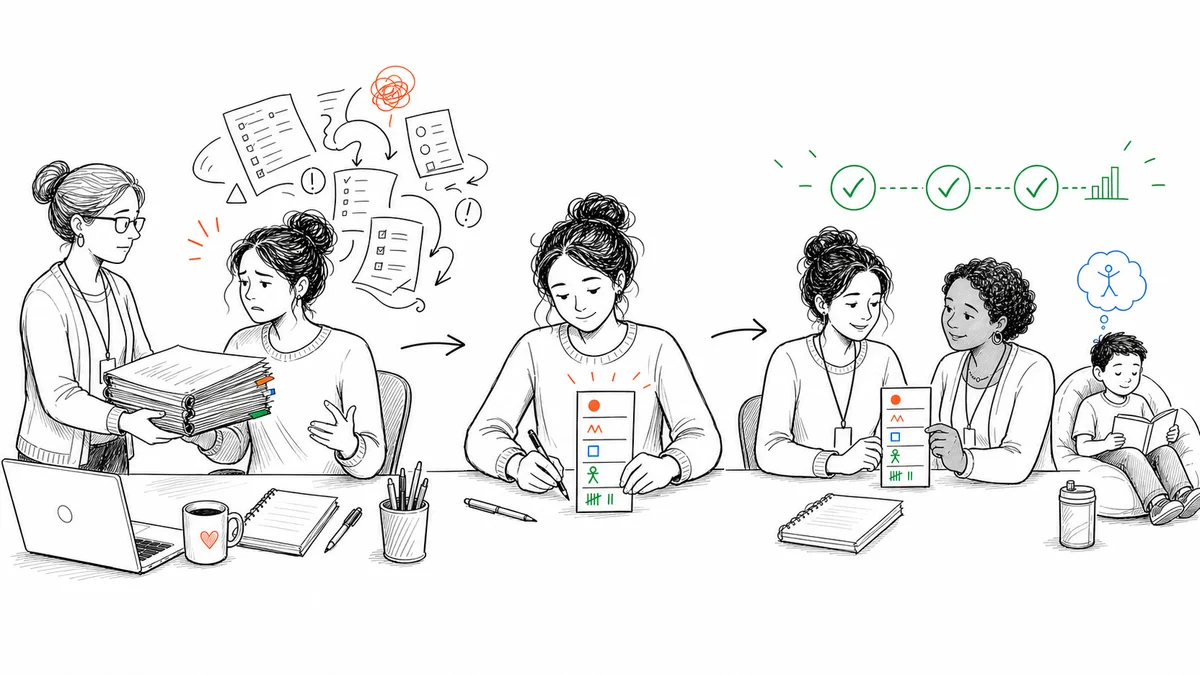
This post is going to break down exactly what a behavior intervention plan looks like in the real world. You will get a simplified template that makes sense to a classroom teacher. More importantly, we are going to talk about why that template alone is completely useless unless you have a sustainable way to document it every single day.
What Exactly Is a Behavior Intervention Plan
Before we get to the template, we have to strip away the clinical language. A behavior intervention plan, often just called a BIP, is a formal document that tells a school team exactly how to respond when a student acts out. It is not just a list of punishments. It is a legally binding roadmap designed to teach the student a better way to handle their frustration.
Who Actually Writes This Document
In a perfect world, a BIP is written collaboratively. A team of specialists, administrators, parents, and teachers sit around a table and craft the perfect strategy. In reality, the document is usually drafted by a school psychologist or behavior specialist based on observations and meetings.
As the classroom teacher, you are rarely the primary author of the plan. However, you are almost always the primary implementer. The specialist who wrote the plan will visit your room once a week. You are the one living with the behavior every single day. This creates a massive disconnect between the theory of the plan and the daily execution.
The Difference Between a Plan and Implementation
Having a plan in a filing cabinet does not change a student's behavior. The plan only works if the adults in the building change their responses. If the BIP says the student gets a five-minute break when they become agitated, you have to actually let them take the break. If the BIP says you cannot use public redirection, you have to bite your tongue when they talk out of turn.
Implementing a plan requires a total shift in how you manage your classroom. It is exhausting work, and it requires intense consistency.
Your Free Behavior Intervention Plan Template
If you are asked to draft a classroom-level behavior plan, or if you just want to translate a massive special education packet into something you can actually read, use this simplified template. It covers the absolute necessities without the fluff.
| Category | Details |
|---|---|
| Target Behavior | What exactly does the student do? (e.g., Throws pencils, puts head on desk) |
| Function of Behavior | Why are they doing it? (e.g., Seeking attention, avoiding math work) |
| Replacement Behavior | What should they do instead? (e.g., Ask for help, take a short walk) |
| Interventions & Strategies | How will the teacher respond? (e.g., Provide visual timer, ignore minor tapping) |
| Data Collection Method | How will we prove it works? (e.g., Daily frequency tally, duration log) |
| Who is Responsible | Who is tracking this? (e.g., Classroom teacher, paraprofessional) |
| Review Date | When do we check progress? (e.g., Every second Friday of the month) |
Why a Template Alone Does Nothing
You can fill out that template perfectly. You can memorize the student's triggers. You can provide the visual timer and offer the replacement behaviors. But if you are not documenting the results, the plan might as well not exist.
The real work of a behavior intervention plan is the daily data collection. The template is the hypothesis. The daily documentation is the evidence that proves whether the hypothesis is correct or completely wrong.
When you go back to the IEP team in six weeks, the psychologist is going to ask you if the plan is working. If you just say that the student is still acting up, the team cannot make any adjustments. They need raw numbers. They need to know if the pencil throwing decreased from five times a day to two times a day. They need evidence, not feelings. If the student is also receiving Tier 2 supports through MTSS, see how to document Tier 2 interventions for MTSS for a simple format you can maintain alongside the BIP data.
The Daily Documentation Trap
This is where general education teachers completely burn out. You are expected to teach, manage the room, and simultaneously act as a professional data collector.
The Clipboard Problem
The traditional method for tracking a BIP is a clipboard with a tally sheet. The specialist hands you a grid and asks you to make a checkmark every time the student shows the target behavior.
This works for exactly three days. On the fourth day, you leave the clipboard on your desk while you are helping a student in the back of the room. The behavior happens, and you cannot get to the clipboard. By the end of the week, you are just guessing at the numbers before the bell rings. A paper tracking system is completely incompatible with active teaching.
Why Context Matters More Than Tally Marks
To actually help the student, you have to transition away from paper tallies. You need a system that captures the context of the behavior. A tally mark does not tell the team that the student only threw the pencil after you asked them to read aloud. Context is everything when adjusting a behavior plan.
Making Data Collection Automatic
Because carrying a clipboard around a classroom is incompatible with actually teaching, you need something fast, discreet, and entirely digital. This is exactly where ShortHand fits into the BIP workflow. When a student exhibits a target behavior, pull out your phone and log the exact incident in seconds. No clipboard, no paper grid, just a timestamped note filed automatically under that student's name.
When the special education team asks for your data at the end of the month, you do not have to spend your weekend counting tally marks. You just open ShortHand and pull up every single documented incident instantly. It proves beyond a shadow of a doubt that you are implementing the plan, and it provides the exact data the team needs to make meaningful adjustments.
A behavior intervention plan should not be a burden that breaks your spirit. With the right template and a digital tracking system, it becomes a powerful tool that actually transforms your classroom.
If you want to skip the binder entirely, ShortHand logs it for you in seconds. Try it free at getshorthandapp.com
Related reading:
- Behavior Intervention Plan for Off-Task Behavior
- Behavior Intervention Plan vs. IEP: What's the Difference
- IEP Behavior Documentation Checklist for Teachers
- Teacher Documentation Log Template
Part of The Teacher's Complete Guide to Documenting Student Behavior.
Stop trying to remember everything.
Try ShortHand Free →