The Only Teacher Documentation Log Template You Actually Need
We have all been down the Pinterest rabbit hole. You search for teacher organization ideas and find hundreds of beautifully designed, color-coded documentation binders. They have cute fonts. They have floral borders. They look absolutely perfect for about three days.
Then reality hits. A student has a meltdown during a fire drill. You have to call three parents during your twenty-minute lunch break. Suddenly, that beautiful binder feels like a massive burden. You stop filling it out because it takes too long to find the right page, write the date, and fill in the tiny boxes.
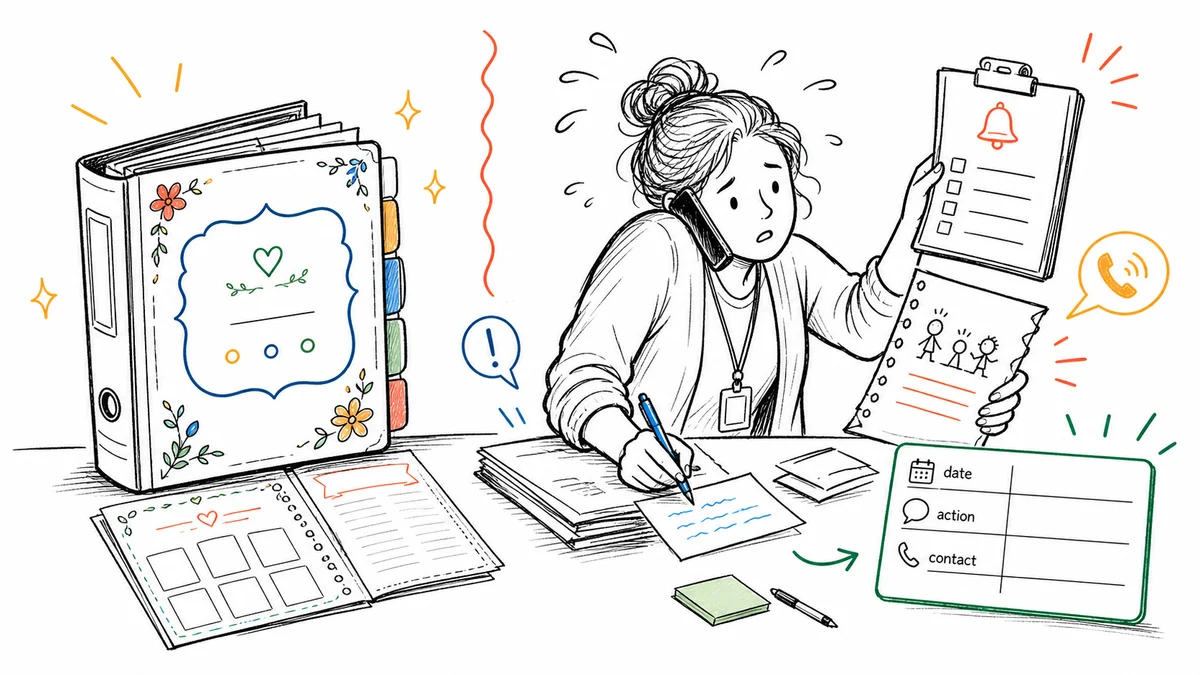
A teacher documentation log does not need to be pretty. It needs to be functional. It needs to capture the exact details of an incident as quickly as possible so you can get back to teaching. In this post, you will get a straightforward, no-nonsense template that actually works in a real classroom. More importantly, we are going to talk about how to use it so you do not abandon it by October.
Why You Need a Documentation Log Yesterday
Relying on your memory is the most dangerous game you can play as a teacher. When you are standing in front of a classroom, you make thousands of micro-decisions a day. You cannot possibly remember exactly what a student said on a Tuesday three weeks ago.
That lesson is one of the main reasons I built ShortHand. At first, I convinced myself I would remember the important details. Then a parent meeting, SST meeting, or report card would come around and I'd realize I was trying to reconstruct weeks of events from memory. The problem wasn't that I wasn't paying attention. The problem was that I was teaching all day. Human memory was never designed to track dozens of students, hundreds of interactions, and months of history without a system.
A documentation log gives you something better than memory. It gives you a record. When a parent asks about a concern, an administrator wants context, or a student support meeting comes around, you are working from facts instead of trying to piece together what happened weeks earlier.
The Free Teacher Documentation Log Template
Keep it simple. You do not need checkboxes for every possible behavior. You just need space for the facts. You can create this in a digital document, or you can print it out and keep it on a clipboard.
| Date & Time | Student Name | Incident / Observation | Action Taken / Consequence | Parent Contacted (Y/N & Method) |
|---|---|---|---|---|
| 10/14 9:15am | Sarah Jenkins | Refused to sit in assigned seat. Said "Make me." | Verbal warning, moved seat after class. | N |
| 10/14 2:30pm | Marcus Cole | Threw pencil across room, hit another student. | Sent to hallway. Office referral written. | Y - Called mom at 3:15pm, left voicemail. |
| 10/15 10:00am | David Smith | Slept through entire math lesson. | Woke him up twice. Offered water. | N |
How to Use This Template Effectively
The incident column is where you must be objective. Do not write that a student was being annoying. Write exactly what they did. If they spoke out of turn five times, write that down. If they used profanity, quote the profanity exactly.
The action taken column is equally critical. You must show that you attempted to correct the behavior before escalating it. Document your verbal warnings, your seat changes, and your private conversations in the hallway. This proves you are managing your classroom proactively.
Where to Store Your Log
If you are using paper, this log must live somewhere accessible but totally private. You cannot leave a clipboard with behavior notes sitting on your desk where other students can read it. That is a privacy violation. Keep it in a locked desk drawer or a specific, dedicated folder that never leaves your bag.
Here is the log itself as a print-ready PDF: date and time, student, what happened, what you did, whether you contacted home, and the follow-up.
Download the documentation log→One page, six columns, print as many as you need. No sign-up required.
Why a Template Alone Will Not Save You
Having a template is only ten percent of the battle. The other ninety percent is building the habit. Countless teachers print out beautiful templates in August and have completely blank logs by November. If you want to set yourself up to actually use it, read the guide on how to document student behavior from day one before the school year starts.
I've learned that most documentation systems don't fail because they're poorly designed. They fail because they're too hard to use in the middle of a real school day.
The physical act of finding a binder, opening the rings, finding the student's page, and writing with a pen is often too much friction during a chaotic school day. A template is just a piece of paper. It cannot force you to remember to write things down.
The "Document Before You Forget" Rule
The only way to maintain a documentation log is to adhere strictly to the rule of documenting before you forget. You have to capture the data in the moment.
If you try to save all your logging for Friday afternoon, you will fail. You will forget the details, and the task will feel overwhelming. You have to log the incident the moment the class transitions, or the moment you sit down for lunch.
Why End-of-Day Logging Usually Fails
A lot of teachers plan to catch up on documentation after the bell. The problem is that by the time contract hours end, the specific details are already fading. You remember that something happened with a student during third period. You cannot remember exactly what was said, what triggered it, or what you tried first. The note you write at 4pm is vaguer than the note you would have written at 10:23am, and a vague note is not much use at a parent meeting or an IEP.
This is not a willpower problem. It is a timing problem. The only log entry worth making is the one you make during the transition, before the next class starts, while the facts are still clear. Thirty seconds at the moment beats ten minutes of reconstruction after school.
Building a Sustainable Documentation Habit
To make documentation sustainable, you have to remove the friction. This means transitioning away from paper whenever possible. Paper gets lost. Paper gets coffee spilled on it. Paper cannot be searched instantly when an administrator walks into your room asking about a specific student.
The digital version of this log that lives right in your pocket is exactly what ShortHand was built for. Instead of lugging around a clipboard, you just open the app. ShortHand automatically logs the date and time and organizes everything by student. You can type the incident in twenty seconds and it is securely saved.
Whether you use a paper template or a digital tool, the key is consistency. Do not let minor behaviors slide. Document everything, stick to the facts, and you will have what you need when it matters. If you are documenting Tier 2 interventions as part of an MTSS plan, here is a simple format built specifically for that.
If you want to skip the binder entirely, ShortHand logs it for you in seconds. Try it free at getshorthandapp.com
Related reading:
- How to Document Student Behavior as a Teacher
- Teacher Documentation Forms vs. Apps: What Actually Works
- Student Behavior Log for Teachers: What to Track and Why
- How to Track Student Behavior Data
- Why Summer School Is the Perfect Time to Build a Documentation System Before September
Part of The Teacher's Complete Guide to Documenting Student Behavior.
Frequently Asked Questions
Stop trying to remember everything.
Try ShortHand Free →