How to Document Parent Contact as a Teacher (So You're Always Covered)
Because 'I'm pretty sure I called' is not going to hold up in a parent conference.
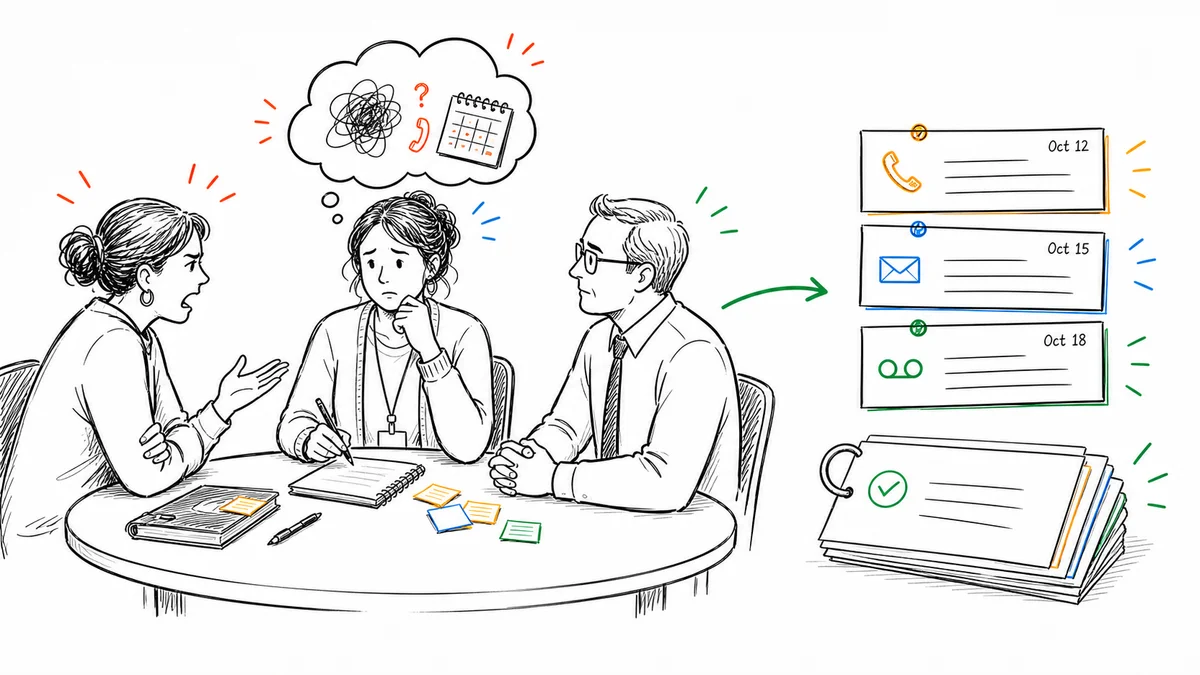
Picture the scene. You are sitting at a small table during fall conferences. A parent looks you in the eye and insists no one ever called them about their child throwing chairs in the cafeteria. They are visibly upset. They are loud. The principal is sitting next to them.
You know for a fact you called them three weeks ago. You even left a voicemail. But you have no proof. You look at your desk, hoping a magical sticky note appears. It does not. The conversation goes sideways fast. You look like the disorganized teacher who let a kid fail.
If you want to survive this job, you need to know exactly how to document parent contact as a teacher.
I have spent twenty years in education, including work as a Registered Behavior Technician. I have sat through more IEP meetings than I can count. The one universal truth in education is this: if it is not written down, it did not happen.
The Problem With Relying on Your Memory
Memory alone is not going to save you. Teachers make thousands of micro-decisions every single day. We manage thirty kids at a time. We wipe noses, tie shoes, break up fights, and try to teach fractions somewhere in between.
Expecting your brain to perfectly recall a five-minute phone call from a month ago is unreasonable. (My brain occasionally forgets where I put my coffee mug while I am currently holding it.)
Vague notes are equally useless. A sticky note on your desk that says "called Mom" tells you nothing in a meeting with an administrator. A random entry in your planner that just says "behavior issue" gives you zero context. You need a complete, searchable contact record. If you're still deciding what to log it in, this comparison of parent communication apps looks at which ones actually keep that kind of record versus which ones just send messages.
Exactly What to Document for Every Parent Contact
You do not need to write a novel. You need specific data points. Every single time you reach out to a home, your log needs to capture these elements.
Date and time. Every entry needs a timestamp. When a parent says they were at work and could not answer, you want to show that you called at 4:15 PM, well after their shift ended. Exact times remove ambiguity and show precision.
Method of contact. Did you call? Send an email? Pull them aside at dismissal? Write it down. A phone call carries a different weight than a classroom app message. If things escalate to a formal meeting, everyone involved will want to know exactly how you reached out.
Who you reached. Did you speak to mom? Did dad pick up? Did you get voicemail? Did it ring ten times with no answer? If mom claims she never heard from you but your log shows you spoke to dad twice, that changes the entire narrative.
A brief factual summary. Stick to the facts. What was the issue? What was agreed on? "Called home about missing homework. Spoke to dad. He said he will check the backpack tonight." That is all you need. No emotion. No editorializing. Objective facts only.
Any agreed follow-up. If you told a parent you would check in again in two weeks, write that down. Otherwise it disappears, and that erodes trust faster than not calling at all.
Why Logging Failed Attempts Matters Just as Much
This is where most teachers slip up. We only log the conversations that actually happen. But an unanswered phone call is still a record of your outreach.
If you call and no one answers, write that down. If you leave a voicemail asking for a callback, write that down. "Left voicemail" is documentation. "No answer" is documentation.
When a parent claims you never tried to reach them, showing three logged attempts with no response proves you did your job. The ball was in their court. You cannot force a parent to pick up the phone, but you can prove you dialed the number.
The Payoff: When the Receipts Speak for Themselves
Back to that fall conference. The parent is upset. They claim you never informed them about the behavior issues. They are gearing up for a fight.
Instead of scrambling or getting defensive, you calmly open your log. You turn your screen so they can see it. Three distinct entries:
- October 12: Voicemail left at 3:30 PM.
- October 15: Phone rang, no answer at 4:00 PM.
- October 18: Email sent at 8:00 AM.
The parent looks at the screen. The anger deflates. The conversation pivots from "why did you not tell me" to "how do we fix this." The confrontation is over in thirty seconds.
That is the power of a good log. It keeps the conversation grounded and keeps the focus on the student.
How ShortHand Handles This Automatically
Writing all of this by hand takes time. Updating a spreadsheet at the end of a long day is exhausting. You need a system that works with you, not against you.
This is why I use the ShortHand app. Every parent contact entry is automatically timestamped and tied to the student. No separate log to maintain. No spreadsheet to format. You type a quick note and it is saved.
When something comes up in a conference, you pull it up on your phone right there at the table. The full contact history for that student, sorted by date, in about ten seconds.
Stop relying on sticky notes and memory. Try ShortHand free at getshorthandapp.com and get your documentation under control.
Related reading: The Only Teacher Documentation Log Template You Actually Need | The Ultimate Parent Phone Call Script for Teachers
Part of The Teacher's Complete Guide to Parent Communication.
Stop trying to remember everything.
Try ShortHand Free →