How to Write a Student Behavior Report (With a Full Example)
The five parts of a report that holds up in meetings, a complete worked example, and the wording traps that undo them.
The email usually arrives on a Tuesday. The counselor, the case manager, or an assistant principal writes: "Can you put together a report on his behavior lately? The team is meeting Friday."
And you think: I have a hundred mental snapshots of this kid and nothing on paper, or a pile of notes in four different places. What exactly is a "behavior report"? How formal? How long? What are they going to do with it?
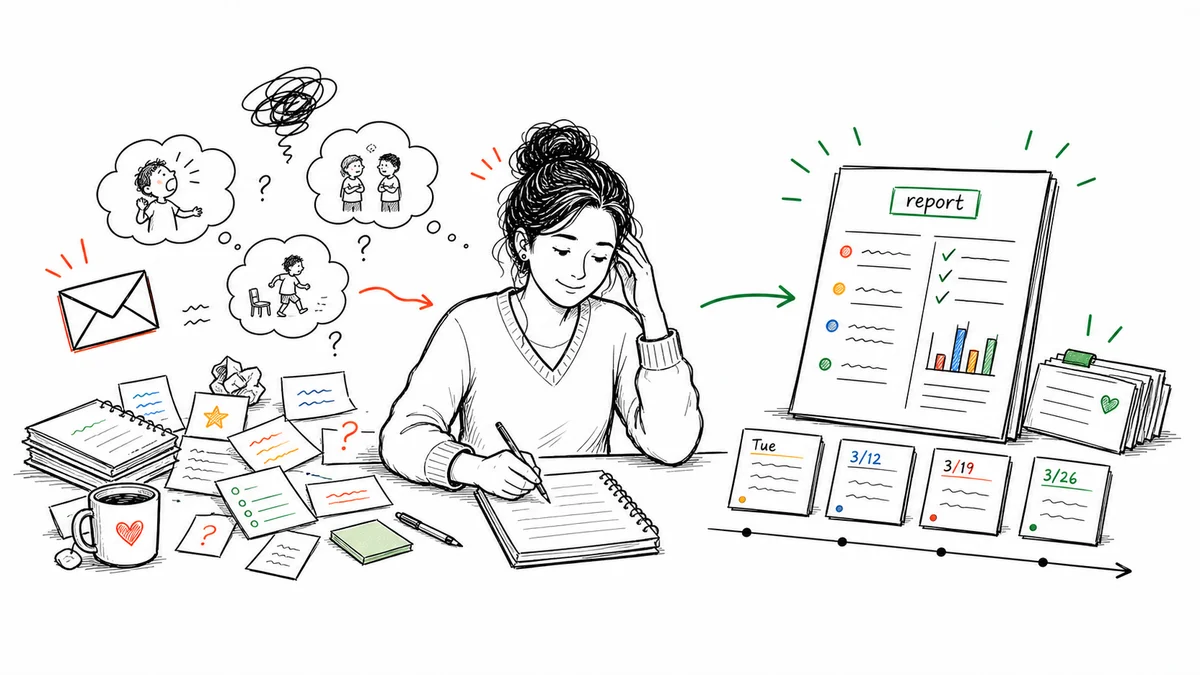
I have been on both sides of this document. As a Registered Behavior Technician, behavior reports were my daily output, read by BCBAs and parents. As a teacher, I have written them for IEP teams and intervention meetings. The format below is the one that has never failed me: five sections, all facts, everything traceable to a dated note.
First, know what you are being asked for
A behavior report is not an incident report. An incident report covers one event. A behavior report summarizes a pattern: what behaviors, how often, in which settings, what has been tried, and whether it is getting better or worse. If your school wants a single-event write-up instead, that is a different document with different rules.
The report you write may end up in front of parents, an IEP team, an evaluator, or, in rare and unpleasant cases, a lawyer. That is not a reason to be scared of writing one. It is a reason to write only things you observed, with dates. Facts are unimpeachable. Interpretations are where reports fall apart.
The five sections
1. Context
Student initials or name (follow your school's convention), your name and role, the date range the report covers, and the settings you observed (your classroom, recess, specials). Two or three sentences. This tells the reader exactly what your report can and cannot speak to: you are the source for math class, not for the bus.
2. Behaviors, described objectively
Name each behavior in observable terms and give its frequency. "Disruptive" is not a behavior; it is a category. "Calls out during instruction," "leaves assigned area," "tears up his own work" are behaviors. Numbers beat adverbs: "4 to 6 times per class period" says something; "constantly" says only that you are tired, which the reader already assumed.
3. Patterns and triggers
When and where does the behavior show up, and when does it not? This section is often the most valuable one in the room, because you are the only person who sees the child six hours a day. "Nearly all incidents occur during independent writing tasks; I have zero recorded incidents during science labs or partner work" can redirect an entire intervention plan.
Stick to observed correlation, not diagnosis. "Incidents cluster in the 30 minutes before lunch" is an observation. "He acts out because of low blood sugar" is a guess dressed as a fact.
4. Interventions tried and the response
List what you have implemented, roughly when, and what happened, including the honest nulls. "Moved seat 2/10: no observable change. Began check-in/check-out 2/24: callouts dropped from daily to 2 to 3 per week over the following month." Teams waste meetings proposing strategies someone already tried; this section prevents that.
5. Summary
Three or four sentences of factual wrap-up: overall trend, current status, and what you need. You are allowed to make a professional request ("I would welcome the team's guidance on supports for independent work time"). You are not writing recommendations for diagnosis, placement, or medication. Not your lane, and putting it in writing creates problems.
A complete example
Here is what all five sections look like assembled. Details are invented; the shape is real.
Behavior Summary Report
Student: J.M., Grade 3 | Prepared by: G. Lebed, classroom teacher Period covered: March 1 to April 12 | Settings observed: classroom, hallway transitions, recess (M/W/F duty)
Behaviors observed. During this period I recorded three recurring behaviors. (1) Calling out during whole-group instruction: 3 to 5 instances per day in early March, currently 1 to 2 per day. (2) Leaving assigned seat during independent work: 14 recorded instances across the period, typically 3 to 4 per week. J. returned to his seat within one minute of a verbal prompt in all recorded instances. (3) Crumpling or tearing his own written work: 6 recorded instances, all during writing tasks of a paragraph or longer.
Patterns. All work-destruction instances and 11 of 14 out-of-seat instances occurred during independent writing or multi-step independent tasks. I have no recorded instances during science labs, partner reading, or recess. Frequency across all three behaviors is highest on Mondays and after schedule disruptions (assemblies on 3/9 and 3/27 were followed by the two highest-frequency afternoons in my notes).
Interventions and response. Preferential seating near my desk began 3/8: no observable change in out-of-seat frequency. Breaking writing tasks into single-paragraph chunks with a check-in began 3/18: work destruction dropped from roughly twice weekly to two total instances since. A two-minute warning before transitions began 3/22 and out-of-seat instances have declined in the weeks since, though I cannot separate this effect from the chunking change.
Summary. Across six weeks, all three behaviors show a downward trend, with task chunking during writing associated with the clearest improvement. Behaviors remain most frequent during long independent tasks and after schedule changes. I will continue current supports and would welcome the team's input on writing accommodations. My dated notes for all instances referenced here are available on request.
Notice what makes that report strong: every number comes from somewhere, every claim is observable, the nulls are reported alongside the wins, and there is not one sentence about why J. "is" the way he is. It reads calm. Calm is credible.
The wording traps
- Instead of: "J. is defiant and disrespectful." Write: "When given a direction to begin writing, J. said 'no' and put his head down (3/4, 3/11, 3/19)."
- Instead of: "He does it for attention." Write: "Callouts occurred most often when classmates laughed in response." The function guess belongs to the BCBA or school psychologist; the observation belongs to you.
- Instead of: "His behavior is worse than anyone else in the class." Write: nothing. Other students never belong in a report about this one.
- Instead of: "Probably ADHD." Write: absolutely nothing of the kind, ever. Describing attention behaviors is your job; naming disorders is a diagnosis.
If this language style is new to you, our guide on how to document student behavior as a teacher drills the objective-writing habit, and the complete behavior documentation guide covers the whole system this report sits on top of.
The part nobody says out loud
A behavior report is only as good as the notes behind it. The example above cites dates and counts because the teacher had dated notes to count. Without them, "14 instances across six weeks" becomes "a lot, I think," and the report you write Thursday night is really a memory exercise with formatting.
This is exactly the problem ShortHand exists to solve. You log a one-line note in about ten seconds when something happens ("left seat 3x during writing, returned w/ one prompt"). Months later, when the Tuesday email arrives, every note for that student is already dated, sorted, and searchable, and ShortHand can draft the summary from your own records. The Friday meeting report becomes a fifteen-minute edit instead of a two-hour reconstruction. If a meeting is coming, our checklist on what to bring to a parent-teacher conference about behavior pairs well with it.
Try ShortHand free. The next time someone asks for "a report on his behavior lately," you will already have it.
Gregory Lebed is a 3rd grade teacher with 20+ years in education and a former Registered Behavior Technician. He built ShortHand to help teachers spend less time on paperwork and more time teaching.
Frequently Asked Questions
Stop trying to remember everything.
Try ShortHand Free →