The Teacher's Complete Guide to Documenting Student Behavior
What to track, how to track it, and why it matters
Most teacher preparation programs cover behavior management strategies. Very few cover what happens after the strategy.
What happens when the intervention is not working and you need to show the team what you have tried. What happens when a parent says their child would never do that. What happens when an IEP meeting arrives and you are expected to present behavioral data you have not been systematically collecting.
Documentation is the part of behavior management that nobody teaches, and it is the part that holds everything else together.
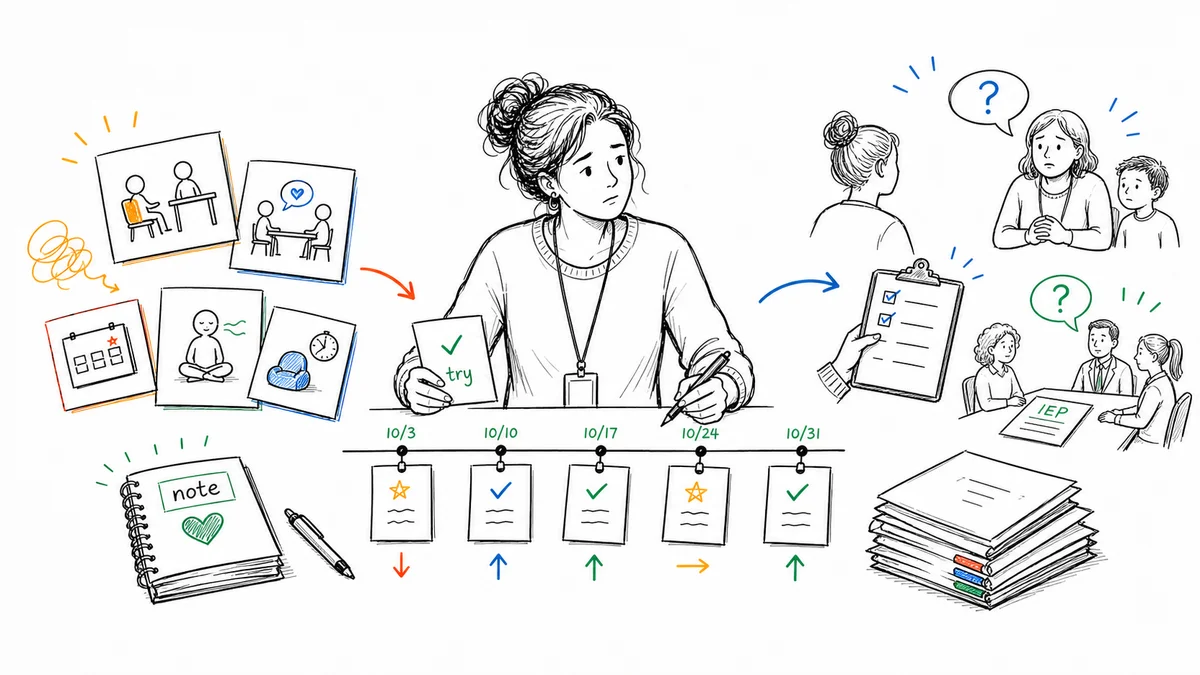
This guide covers the full picture: daily behavior logs, tracking systems, intervention plans, IEP documentation, and the habits that make all of it sustainable.
Why documentation matters more than the strategy
Teachers spend enormous energy finding the right intervention for a difficult behavior. Much less energy goes into recording what happens.
That is backwards.
The documentation is what lets you know if the intervention is actually working. It is what you bring to a parent meeting when they have questions about what happened. It is what a special education team needs to write a meaningful IEP goal. It is what gives you a clear record if a situation escalates.
A behavior management strategy without documentation is just a hope. Documentation turns it into evidence.
Building a daily behavior log
The best behavior log is the one you will actually maintain. That usually means simple.
The Student Behavior Log: What to Track, How to Track It, and Why It Actually Matters breaks down exactly what to record for each incident: the date, setting, what the behavior looked like in observable terms, what happened before and after, and any intervention used. Brief is fine. A two-sentence entry made the same day is worth more than a detailed account written a week later.
For a ready-to-use format, The Only Teacher Documentation Log Template You Actually Need gives you a simple structure that works whether you prefer paper, a spreadsheet, or an app.
If you are weighing your options, Teacher Documentation Forms vs. Apps is an honest comparison of what actually works in a real classroom, not just in theory.
Tracking behavior data over time
A single observation is a moment. A pattern is data.
If you are documenting for IEP purposes, for a behavior intervention plan, or just trying to understand what is actually happening with a student, you need enough entries over enough time to see the shape of the behavior.
How to Track Student Behavior Data covers the specific metrics that matter: frequency, duration, and intensity. It also covers how to collect data during a real school day when you cannot stop teaching to write things down.
How to Track Student Behavior in the Classroom gets into the practical systems: tally marks, ABC charts, interval recording, and which method fits which type of behavior.
5 Student Behavior Patterns Teachers Should Never Ignore covers what to look for once your tracking is in place: task avoidance, time-of-day triggers, repeated peer conflicts, sudden behavioral shifts, and constant redirection that has become invisible.
How to Document Student Behavior as a Teacher covers the day-to-day habit: what to write, when to write it, and how to keep it going when things are busy.
If a student is getting Tier 2 support through your school's MTSS process, How to Document Tier 2 Interventions for MTSS lists common Tier 2 interventions and what to record for each one so the team can tell whether it is working.
Documenting behavior for digital records
Paper works. But it gets lost, left at school, and is hard to search when you need a specific incident three weeks later.
Digital Tools for Recording Student Incidents and Progress covers the options for moving behavior documentation into a format you can access anywhere, search quickly, and share with a team when needed.
If your documentation leans more toward anecdotal and skill observations than incidents, Student Observation Apps: What Actually Works compares paper, spreadsheets, forms, and dedicated apps against the only test that matters: whether you can use them mid-lesson.
ShortHand was built specifically for this problem. You log a behavior note in a few seconds from your phone, right after it happens, without opening a laptop or filling out a form. Over time those quick notes become a searchable, timestamped record.
Behavior documentation for IEP students
IEP documentation has higher stakes than general behavior tracking. What you write becomes part of a legal document. What you bring to an IEP meeting shapes the goals, supports, and services a student receives.
How to Document Student Behavior for IEP Meetings covers the specific format IEP teams need: observable descriptions, baseline data, frequency and duration counts, and how to connect your classroom observations to the language of the IEP.
When it is time for the annual review, The IEP Behavior Documentation Checklist walks you through exactly what to bring so you are not scrambling the night before the meeting.
And when the team asks you to "put together a report on his behavior lately," How to Write a Student Behavior Report gives you the five-section format, a complete worked example, and the wording traps to avoid.
Behavior Intervention Plans
A Behavior Intervention Plan (BIP) is a formal document that identifies a specific problem behavior, defines replacement behaviors, and outlines the supports and strategies the team will use. It is attached to an IEP and is legally binding.
The Behavior Intervention Plan Template That Actually Works gives you a practical structure for writing or reviewing a BIP, with language that translates into real classroom implementation.
Surviving a Behavior Intervention Plan for Off-Task Behavior covers the most common type of BIP teachers deal with: the student who is not disruptive in an obvious way but is consistently disengaged, avoidant, or off-task.
If you are trying to understand the difference between the documents, Behavior Intervention Plan vs. IEP clarifies the relationship between the two and what each one actually requires from the classroom teacher.
When documentation saves you
The situations where documentation matters most are the ones you cannot predict.
A parent who denies the behavior happened. An administrator who asks what interventions you have tried. A due process hearing where your notes are the only contemporaneous record. A new teacher taking over your class mid-year who needs to understand a student's history quickly.
None of these feel urgent when things are going fine. They feel very urgent when they arrive.
The teachers who navigate these moments with confidence are the ones who have been logging consistently, not because they anticipated the problem, but because they built the habit before they needed it.
ShortHand is built to make that habit realistic. Quick notes, right from your phone, automatically saved with a timestamp. No forms, no extra steps, no catching up on a Friday afternoon.
Try ShortHand free and see what consistent documentation actually looks like when the tool does not get in the way.
Gregory Lebed is a former Registered Behavior Technician (RBT) and third grade teacher. He built ShortHand after realizing how much teacher stress comes from not having written things down sooner.
Frequently Asked Questions
Stop trying to remember everything.
Try ShortHand Free →