How to Document Student Behavior Without Losing Your Mind
If you have been teaching for more than a week, you already know the feeling. You are sitting in a conference room. Across the table is a parent who is absolutely convinced their child is a perfect angel. Next to them is an administrator looking at you expectantly. You know this student has been disrupting your class every single day since September. You know they throw pencils, refuse to work, and curse under their breath.
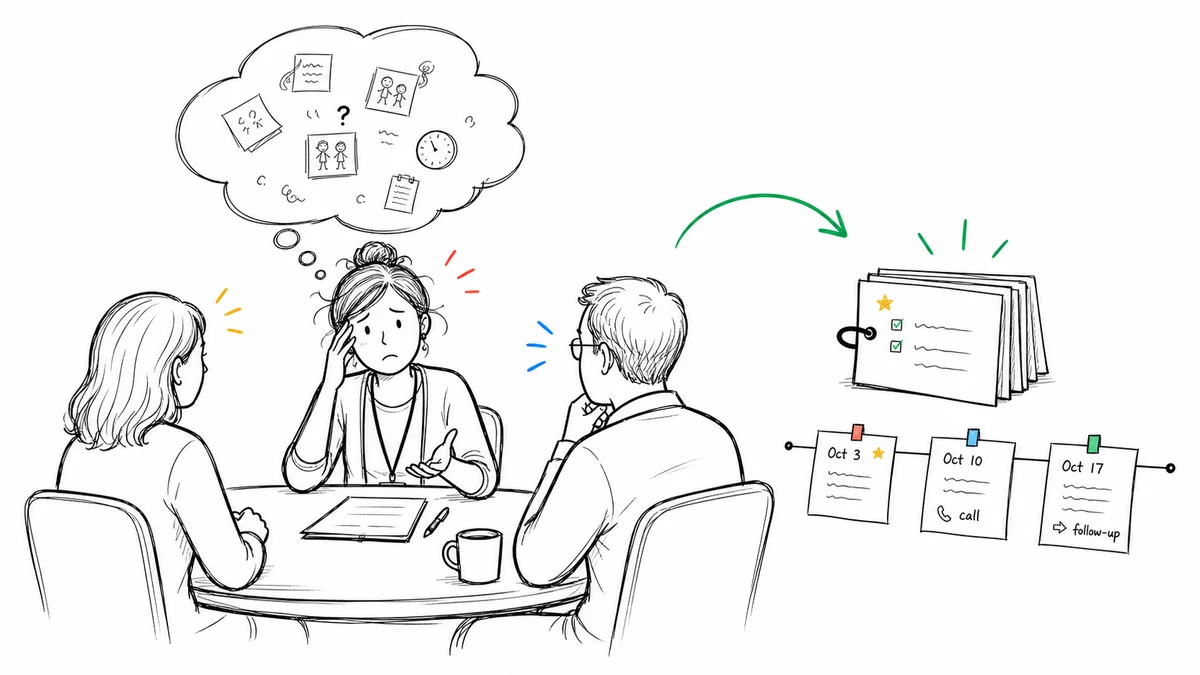
But when the parent asks for specific examples, your mind goes blank. You stammer out something vague about them being off-task. The parent crosses their arms. You look like you are exaggerating. In that moment, you realize the hardest truth of teaching. If it is not written down, it simply did not happen.
I learned that lesson the hard way. When I started teaching, I relied almost entirely on memory. I always assumed I would remember the important incidents, the parent phone calls, and the patterns that seemed obvious in the moment. Then a meeting would come around weeks later and I would realize I was trying to reconstruct events from memory alone. That frustration eventually became one of the main reasons I built ShortHand.
Learning how to document student behavior is not something they teach you in your education program. They teach you theories about classroom management. They do not teach you how to keep a clear, organized behavior record while simultaneously teaching thirty-two middle schoolers how to find the area of a circle.
This is a practical guide written by a real teacher. We are going to cover exactly what to write down, when to write it, and why the systems you are currently trying to use are probably setting you up for failure.
Why Most Teachers Wait Too Long to Document
The biggest mistake teachers make is waiting for behavior to become severe before they start writing it down. We are naturally optimistic people. We want to believe that the little redirect we gave on Tuesday will fix the problem by Wednesday.
The Illusion of Memory
You tell yourself you will remember what happened. A student makes a highly inappropriate comment during third period. You are in the middle of a lesson, so you handle it verbally and tell yourself you will write it down during your planning period.
But then fourth period happens. Then a student throws up in the hallway. Then you have recess duty. By the time your planning period finally arrives, you are just trying to grade a stack of quizzes and go to the bathroom. The exact phrasing the student used is gone from your memory. You decide it was not that big of a deal anyway. Two weeks later, when that same student does something much worse, you have no record of the escalating behavior.
That may not sound important until you're sitting across from a parent, administrator, or support team trying to explain what happened. Small details disappear quickly. The problem is not that teachers are careless. The problem is that we process hundreds of interactions every day and memory has limits.
The Fear of Being Dramatic
Many teachers hesitate to document minor infractions because they feel like they are being petty. You might think that logging a student for rolling their eyes or refusing to take out a pencil is a waste of time. But behavior documentation is not about being petty. It is about establishing a baseline.
When you have to refer a student to the office or call a parent, a single incident looks like an anomaly. A log of fifteen minor incidents over a three-week period paints a very clear picture of defiance and disruption. You need the history to justify the consequence.
The "Same Day" Rule for Behavior Logs
If you want your documentation to actually be useful, you must follow the same day rule. You cannot log behavior on Friday that happened on Monday. Memory degrades fast when you process interactions with over a hundred students a day.
If you wait days to write something down, your notes lose their specificity. Details blur. A parent or administrator asking about a specific incident will get a vague answer because you no longer remember the exact sequence. Write it down on the same day it happens.
This sounds exhausting, but it does not have to be. The trick is to stop writing essays and start writing bullet points. You do not need to write a novel about how the incident made you feel. You just need the core facts logged before you leave the building.
Exactly What Details Actually Matter
When you sit down to write a behavior note, you might feel the urge to explain the entire context of your lesson plan. Nobody needs to know that you were transitioning from the vocabulary warm-up to the group project. Keep it entirely focused on the student.
Write Quotes, Not Summaries
This is the single most important rule of teacher documentation. Stop summarizing student behavior. Summaries are subjective and open to interpretation. Quotes are objective facts.
Do not write: "Marcus was being very disrespectful and using foul language when I asked him to work."
Write this instead: "Asked Marcus to open his textbook to page 42. Marcus threw his textbook on the floor and said, 'I am not doing your stupid work.' I calmly asked him to pick up the book. He refused and put his head on the desk."
When a parent reads the first example, they might argue about your definition of disrespectful. When a parent reads the second example, there is no argument to be made. The quote speaks for itself. ShortHand is incredibly helpful for this because you can quickly type the exact quote into your phone the second the class ends, before you forget the exact phrasing.
When You Are Too Stressed to Write Calmly
After a difficult incident, the words that come to mind first are usually not the ones that belong in a professional record. That is normal. The goal in the moment is not to write the perfect note. It is to capture the facts before they disappear.
A quick placeholder logged right after class works fine: "refused to return to seat, raised voice when redirected, left room without permission." That gets the core facts down while they are still accurate. Later in the day, before you leave the building, you can expand it into objective, professional wording with the full sequence of events. You still have the facts. You are just no longer writing from the middle of the frustration.
Stick to the Facts, Leave Out Your Feelings
Your behavior log is a professional document. It may be read by your principal or shared at an IEP meeting. Keep your emotions completely out of it.
Avoid words like angry, aggressive, malicious, or lazy. These are judgments. Instead, describe the physical actions that led you to those conclusions. Instead of saying a student was aggressive, say they slammed their fists on the desk and stood up abruptly. Let the reader draw their own conclusions from the undeniable facts you present.
When to Start Logging
You should start logging behavior the moment a student requires more than a standard, whole-class redirection. If you have to specifically use a student's name to correct behavior more than twice in one class period, start a log.
It is always better to have notes you never need than to need notes you never wrote. Over the years, I've never regretted having too much documentation. I have absolutely regretted assuming I would remember something later.
Start documenting early in the year. If a student is constantly out of their seat in September, document it. If they talk over you every time you give instructions, document it. This early documentation is gold when you are trying to get a student tested for an IEP or when you need to justify moving their seat away from their friends.
Making Documentation Sustainable
The reason teachers hate documentation is that it feels like a massive chore at the end of an exhausting day. Sitting at a desk with a binder full of paper logs, trying to decipher your own sticky notes, is a miserable experience. You need a system that fits into the tiny cracks of time during your school day.
This is why many teachers are moving away from paper logs entirely. You need to be able to log a behavior in under thirty seconds while walking down the hallway. ShortHand is built exactly for this. Pull out your phone, select the student, type the quote they just said, and save it. It takes seconds. There is no binder to carry. There is no paper to lose.
Build a habit of immediate, factual documentation. It will change the way you manage your classroom and make parent meetings significantly easier.
If you want to skip the binder entirely, ShortHand logs it for you in seconds. Try it free at getshorthandapp.com
Related reading:
- The Only Teacher Documentation Log Template You Actually Need
- Teacher Documentation Forms vs. Apps: What Actually Works
- How to Document Student Behavior for IEP Meetings
- Student Behavior Log for Teachers: What to Track and Why
- Report Card Comments for Behavior: 120+ Examples
Part of The Teacher's Complete Guide to Documenting Student Behavior.
Stop trying to remember everything.
Try ShortHand Free →