Your First Year as a Special Education Paraprofessional: Honest Advice from an RBT Turned Teacher
Five lessons on pairing, de-escalation, and documentation from someone who spent over a decade in the classroom before becoming a teacher.
Starting as a special education paraprofessional can feel like being dropped into the middle of a movie after missing the first 45 minutes.
Everyone else seems to know the students, the routines, the acronyms, and what to do when something goes wrong. Meanwhile, you are trying to remember where the extra pencils are while quietly wondering whether "BIP" is a behavior plan or a new sound the copier makes.
I know that feeling.
I did not grow up planning to become a paraprofessional, an RBT, or even a teacher. I studied psychology because I liked working with people and trying to understand why they behaved the way they did. After college, one job led to another. Eventually, I spent 11 years working one-to-one with students on the autism spectrum. Later, I worked as a Registered Behavior Technician in different schools and classrooms before becoming an elementary teacher.
I did not arrive on my first day with a special gift for behavior support. I was scared, inexperienced, and desperate to be useful. I was lucky to work with patient adults who trained me, corrected me, and showed me what good support actually looked like.
It also took me months to feel comfortable in the job.
That may not be the inspiring line people expect, but it is the truth. Special education classrooms can be physically tiring, emotionally demanding, unpredictable, and completely different from anything you have experienced before.
They can also become the places where you do the most meaningful work of your life.
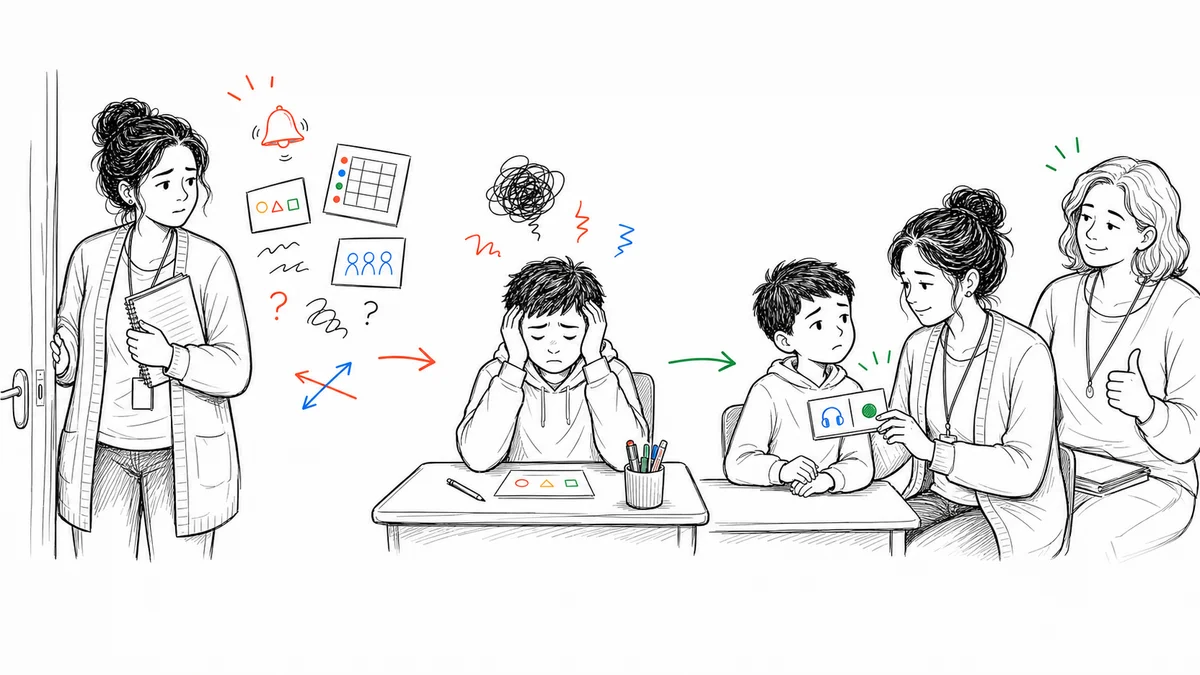
Here are the five lessons I wish someone had explained to me when I started.
1. Build the Relationship Before You Start Making Demands
When you are first assigned to a student, it is natural to want to prove that you can do the job.
You want the student to follow directions. You want the teacher to see that you are capable. You may feel pressure to step in immediately and start correcting behavior.
Slow down.
Before you can consistently ask a student to do difficult things, the student needs to learn that you are safe, predictable, and genuinely there to help.
In behavior support, this is often called pairing. In plain English, it means building a positive relationship before becoming the person who constantly says no, stop, sit down, finish this, or try again.
During your first days with a student, spend time learning:
- What makes the student laugh?
- What activities do they choose during free time?
- What topics do they enjoy talking about?
- What situations make them uncomfortable?
- How do they communicate when they need help?
- What does stress look like before it becomes a larger problem?
This does not mean allowing a student to do anything they want. It means lowering unnecessary demands while you learn about each other.
Give choices when you can. Join preferred activities without taking control of them. Notice what the student does well. Let the student experience you as someone who brings calm, help, and positive attention into the room.
The first student I supported taught me this better than anyone.
I worked with him for several years. He was bright, funny, imaginative, and very capable of making every school day interesting. There were also days when he was angry, aggressive, or completely unwilling to do what was being asked of him.
Over time, however, he understood that I was not his enemy. I was not there to embarrass him, punish him, or win a battle against him. I was there to help him get through the day and become more independent.
That relationship did not prevent every difficult moment. It gave us something to return to after those moments.
A student may not always like the direction you give. They may not like the task, the schedule, or the limit you set. But when they trust the person delivering it, there is a much better chance they will eventually work through it with you.
2. During Escalation, Use Fewer Words and Follow One Plan
My natural response to anxiety is to talk.
When someone is upset, I want to explain, reassure, solve the problem, and offer choices. With many people, that instinct can be helpful.
With an overwhelmed student, it can make everything worse.
When a student is escalating, every sentence becomes additional information their brain has to process. Even a kind offer can feel like another demand.
You may think you are helping by saying:
"It is okay. I know you are upset. We just need to finish these three questions, and then you can choose whether you want your tablet or a walk."
The student may only hear noise, pressure, and more decisions.
A shorter direction is often easier to process:
"First work. Then tablet."
The exact wording depends on the student and the plan your team uses. The larger point is to reduce language, choices, emotion, and negotiation.
Be calm. Be clear. Do not argue. Do not deliver a speech about why the rule exists. A dysregulated student is not in the best state to appreciate your closing argument.
This is also where new staff members sometimes make a well-intentioned mistake. They see another adult working with an escalating student and immediately begin talking to the student too.
They ask what is wrong. They offer a break. They remind the student to use their words. They repeat the teacher's directions in a louder voice.
Now the student has two, three, or four adults adding language to an already overwhelming situation.
More adults do not automatically create more support.
Unless you are asked to work directly with the student, quietly ask the lead adult what would help. You might:
- Move other students to a safer area.
- Remove nearby objects that could be thrown or damaged.
- Clear an exit or pathway.
- Call for additional trained support.
- Bring over a needed visual, communication device, or calming item.
- Supervise the rest of the class so the lead adult can focus.
Follow the student's established plan and the lead adult's direction rather than improvising during a crisis.
Sometimes the best support you can provide is making the environment safer while saying almost nothing.
One last thing: consistency matters. A student who is still learning to regulate and trust adults does not need five competing versions of the rules. If half the room follows one procedure and the other half follows another, the student is not learning flexibility. They are actually learning that expectations change depending on who is standing nearby. The adults must get on the same page before expecting the student to stay there.
3. Do Not Take the Behavior Personally
This may be the hardest lesson in the entire job.
A student may yell at you, insult you, reject your help, throw something, destroy work, or act as though you are the worst person they have ever met.
It can feel personal because you are the person standing there.
Sometimes you are also the person delivering the direction, blocking access to something unsafe, or asking the student to return to a difficult task. That makes you the most convenient target for frustration.
But being the target of a behavior does not mean you are the cause of the emotion behind it.
I remember one especially difficult day with a student I had supported for a long time. He was angry for hours, and nearly all of it appeared to be directed at me. The situation began with a task he did not want to complete, but by the middle of the episode, it felt like the task had disappeared and I had become the problem.
Later, after he had calmed and returned to the work, he pulled a crumpled piece of paper from his pocket. On it was a drawing of his favorite video-game character.
He handed it to me.
He did not apologize. I cannot prove that the drawing was meant as an apology. Maybe I gave the moment more meaning than he intended.
But it felt like his way of telling me that what happened earlier was not the whole story of how he felt about me.
That student taught me to stop carrying one moment into the next.
At first, I learned not to carry Monday's behavior into Tuesday.
Then I learned not to carry the morning into the afternoon.
Eventually, I became better at not carrying 9:00 into 9:15.
That does not mean pretending nothing happened. Serious incidents still need to be addressed, documented, and discussed by the appropriate team. It means giving the student a real opportunity to recover rather than making them spend the rest of the day paying emotionally for their worst moment.
Students need fresh starts more often than adults naturally want to give them.
You will need them too.
You are going to make mistakes. You will talk too much, miss a warning sign, misunderstand a direction, or react with more frustration than you intended.
Learn from it, apologize when appropriate, and begin again.
4. Catch the Smallest Step Forward
When I first started working in behavior support, reinforcement sometimes felt wrong to me.
A student could refuse work, yell, kick, or disrupt the room for a long time. Then the student would follow one direction or answer one question, and I was expected to praise or reward that moment.
My first reaction was: Why are we celebrating one small success after everything that just happened?
Eventually, I understood that the small success was exactly what we needed to strengthen.
You do not build a better pattern by waiting for perfection. You build it by catching the first tiny piece of the behavior you want and making that moment matter.
I once supported a student who found a particular classroom activity extremely difficult. At first, even transitioning into the activity could trigger a major reaction.
One day, the student did not complete the activity.
They did not suddenly become enthusiastic about it.
The student simply tolerated the transition without the intense reaction we had seen before.
We reinforced that step.
At the time, part of me wondered whether we were celebrating the absence of a problem rather than a real accomplishment. But tolerating the transition was an accomplishment. It was the first step that made every later step possible.
Over time, the student became more comfortable entering the activity, remaining in the area, and participating in portions of the routine.
That progress would have been easy to miss if success had only meant independently completing the entire task.
In special education, growth is often built from changes that outsiders may barely notice:
- Entering the room without becoming distressed.
- Sitting for 30 seconds longer.
- Accepting a different cup.
- Asking for a break instead of leaving.
- Completing one problem after refusing the entire page.
- Returning to the group after calming down.
- Keeping hands safe during a difficult transition.
- Tolerating an adult saying, "Not yet."
Notice those moments.
Praise them honestly and specifically. Follow the reinforcement plan established for the student. Do not dismiss progress because it looks small compared with what other students can do.
The goal is not to compare a student with everyone else in the room.
The goal is to help that student take the next possible step.
5. Your Observations Matter More Than You Realize
Paraprofessionals are often the adults who spend the most time next to a particular student.
You see what happens during arrival, transitions, small groups, lunch, recess, independent work, and the minutes before a larger behavior begins. You notice details that a teacher, behavior specialist, or case manager may not be in the room to see.
That makes your observations incredibly valuable.
But there is a difference between an observation and an interpretation.
Consider this note:
"The student misbehaved because he did not want to do his work."
That sounds reasonable, but it includes a guess about motivation.
A more objective note might say:
"When the worksheet was placed on the desk, the student pushed it to the floor, yelled 'no,' and left the work area. The worksheet was removed, and the student sat in the calming area for five minutes."
That note tells the team what happened without pretending we can read the student's mind.
Many behavior teams organize observations using the ABC format:
- Antecedent: What happened immediately before?
- Behavior: What did the student do that could be seen or heard?
- Consequence: What happened immediately afterward?
The word consequence does not automatically mean punishment. It simply means what followed the behavior.
Different behavior plans may require different kinds of data. You might count how many times a behavior occurs, record how long it lasts, check whether it happened during a set interval, or take a brief narrative note.
If you want a fuller breakdown of what to track and how to organize it over time, the teacher's guide to documenting student behavior covers logs, IEP records, and intervention plans in more depth.
Do not pretend to understand the data system if you do not.
Ask questions. Then explain the directions back in your own words so the person training you can correct any misunderstanding before you collect several weeks of unusable information.
A good question might sound like:
"Just to make sure I understand, every five minutes I record whether the behavior is happening at that exact moment, not whether it happened at any point during those five minutes. Is that right?"
That does not make you look unprepared. It makes you look careful.
The world of special education is often counterintuitive. You are not expected to walk in already understanding every behavior plan, accommodation, data sheet, or classroom procedure.
Check your ego at the door and ask.
Your job is not to prove that you already know everything. Your job is to help the student and provide the team with accurate information.
Those notes may later help the team:
- Recognize a pattern.
- Adjust a support strategy.
- Prepare for an IEP or behavior meeting.
- Explain progress to a family.
- Determine whether an intervention is working.
- Notice a trigger that everyone had previously missed.
Years later, that same need to capture accurate observations before the details disappeared became part of why I built ShortHand. But the tool matters less than the habit. Whether you use an app, a district form, or a clipboard, record what you actually observed rather than the story your brain created about it.
Paraprofessionals, RBTs, and classroom teachers often need different things from a documentation tool. If you are trying to figure out what fits your role, this comparison of special education behavior tracking software walks through a few options built for very different parts of the job.
You Do Not Have to Know Everything on Day One
Your first year as a special education paraprofessional may be harder than you expect.
There will be days when you feel useful and connected. There will also be days when you feel as though every decision you made was wrong.
That does not automatically mean you are bad at the job.
Most importantly, remember that a difficult moment is only one moment.
The student gets another chance.
So do you.
Years after learning these lessons, I built ShortHand to solve one of the biggest frustrations I kept running into: capturing accurate observations before they disappeared. If you're curious what that looks like in practice, you can try the guided demo in about two minutes. No account required.
Frequently Asked Questions
Stop trying to remember everything.
Try ShortHand Free →