Email to Parents About a Fight at School: 3 Teacher Templates
How to handle high-stakes safety incidents with professional, documentation-ready communication.
Few phone calls or emails are more stressful than the ones concerning physical altercations.
When a physical fight happens at school, emotions run high for everyone involved, including the students, the parents, the teachers, and the administration. In these high-stakes moments, a poorly phrased email can escalate an already tense situation, which is about as helpful as a screen door on a submarine.
That is why I have a strict rule for serious behavioral incidents: call first, email second.
You should never send an initial notification about a physical fight over email. Written words lack tone, warmth, and empathy. A parent reading a cold email about their child getting into a fight will often panic or become defensive.
Instead, pick up the phone to deliver the news and discuss the immediate steps. Once the phone conversation is complete, you can use email to create a clear, written record of what was discussed.
Below are guidelines and templates to help you write follow-up emails after a physical altercation.
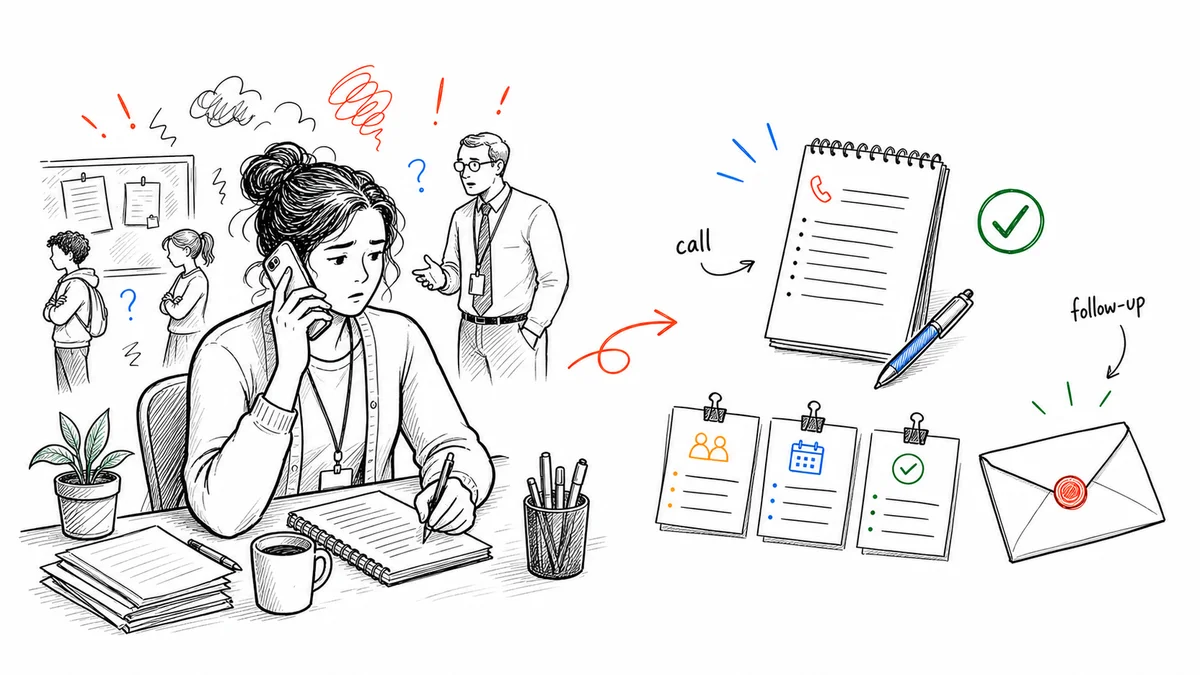
The Golden Rule: Call First, Email Second
Before you touch your keyboard, pick up the phone. Even if you only leave a voicemail and request an immediate callback, you must attempt direct vocal communication first.
During the call, keep your tone calm, objective, and supportive. Describe what occurred using neutral, observable facts rather than emotional labels. For example, say "physical contact" or "altercation" rather than "attack."
Once you have spoken to the parents, you need to document the discussion. Written records give the school, the family, and the student a shared reference point. They prevent misunderstandings about consequences, safety plans, or next steps.
If you need reference templates for other serious behaviors that do not involve physical violence, check out our guide on 5 Sample Emails to Parents About Student Behavior.
How to Document the Incident
When writing a follow-up email about a fight, keep these three rules in mind:
- Protect privacy. Never name other students in your email. Refer to them as "another student" or "peers." This is a legal requirement in most districts.
- Be objective. Stick to what was seen and heard. Avoid speculating about motivation or using loaded words.
- Outline the agreement. Clearly state what was agreed upon during the phone call, including consequences, schedule adjustments, or counseling follow-ups.
Follow-Up Email to Parents About Fight at School Templates
Here are three templates for the different roles a student might play in a physical conflict.
1. The Student Who Participated (Aggressor/Active Participant Side)
Use this template after calling the parent of a student who initiated or actively participated in a physical fight.
Subject: Follow-up: Today's incident and next steps - [Student First Name]
Dear [Parent Name],
Thank you for speaking with me on the phone earlier today regarding the physical altercation involving [Student Name]. I appreciate your cooperation and your commitment to helping us resolve this.
As we discussed, [Student Name] was involved in a physical altercation with another student today at [Time/Location]. School administration intervened immediately to ensure the safety of all students.
To document our phone conversation, we agreed on the following next steps:
- [Student Name] will serve [Consequence, e.g., a one-day suspension/in-school suspension] starting on [Date].
- [Student Name] will meet with the school counselor on [Date] to discuss conflict resolution strategies.
- We will hold a re-entry meeting on [Date/Time] in the main office before [Student Name] returns to class.
Our main goal is to ensure a safe learning environment while helping [Student Name] learn how to manage conflicts peacefully. Please feel free to reach out if you have any questions before our meeting.
Sincerely,
[Your Name]
2. The Student Who Was Hurt or Targeted (Victim Side)
Use this template after calling the parent of a student who was injured, targeted, or caught in the middle of a physical altercation.
Subject: Follow-up: Incident update regarding [Student First Name]
Dear [Parent Name],
Thank you for taking my call earlier today. I wanted to follow up in writing to ensure we have a clear record of our conversation and our plan to support [Student Name].
As we discussed, [Student Name] was involved in an incident today at [Time/Location] where they were [injured/targeted] during a physical altercation between other students. The school medical staff examined [Student Name], and we verified that [describe physical status/actions taken, e.g., ice was applied/no major injuries were found].
To ensure [Student Name] feels safe and supported returning to school, we have put the following measures in place:
- The school counselor will check in with [Student Name] tomorrow morning to offer support.
- We have adjusted supervision during [Transitions/Lunch/Recess] to ensure staff members are nearby.
- [Optional: Describe any schedule or seating changes made for safety].
Please monitor how [Student Name] is feeling tonight. Do not hesitate to contact me if they express any anxiety about returning to class so we can adjust our support plan.
Warmly,
[Your Name]
3. The Student Who Witnessed the Fight and is Distressed (Witness Side)
Witnessing physical violence can be highly distressing for students, especially in elementary and middle school. Use this template after calling the parent of a student who witnessed the altercation and showed signs of distress.
Subject: Follow-up: Supporting [Student First Name] after today's incident
Dear [Parent Name],
Thank you for speaking with me earlier about [Student Name]'s reaction to the incident at school today.
As we discussed, a physical altercation occurred between other students during [Time/Location]. While [Student Name] was not directly involved, they witnessed the event and was visibly upset afterward.
I wanted to put our plan in writing so we can coordinate our support:
- I will monitor [Student Name] closely in class tomorrow and allow them to take a break if they feel overwhelmed.
- We have scheduled a check-in with the school counselor tomorrow at [Time] to help them process what they saw.
- We will keep you updated on how they are doing throughout the day.
If you notice any changes in their behavior at home tonight, please let me know so we can share that context with the counselor.
Best,
[Your Name]
Keeping a Secure, Time-Stamped Incident Log
High-stakes incidents like physical fights require meticulous documentation. If district leadership asks for a timeline of events, or if a parent has questions about what was communicated and when, you cannot rely on memory. You need a reliable, time-stamped history of the incident, the antecedents, and every parent contact.
For other behavioral issues that might lead up to these events, having a template plan is vital. You can reference our article on 5 sample emails to parents about student behavior to see how to document earlier warning signs.
This is why teachers use ShortHand.
ShortHand makes it simple to log student behavioral incidents and parent communication in real time. Rather than digging through chaotic email folders or trying to reconstruct timelines from sticky notes, ShortHand stores everything in a secure, organized log. You have a clean record of what happened and when you communicated with families, giving you peace of mind and protecting your professional record.
If you want a faster way to keep that record, ShortHand lets you log incidents and parent contacts in seconds, right from your phone.
Stop trying to remember everything.
Try ShortHand Free →