The Teacher's Complete Guide to Parent Communication
Every conversation, email, call, and meeting: handled
Most teacher training covers lesson planning, assessment, and classroom management.
It does not cover what to say when a parent tells you their child would never do that. Or how to write a behavior email at 4 PM when you are already emotionally spent. Or what happens at an IEP meeting when a parent disagrees with everything on the document.
Parent communication is one of the most stressful parts of teaching, and most teachers figure it out alone, on the fly, after something has already gone sideways.
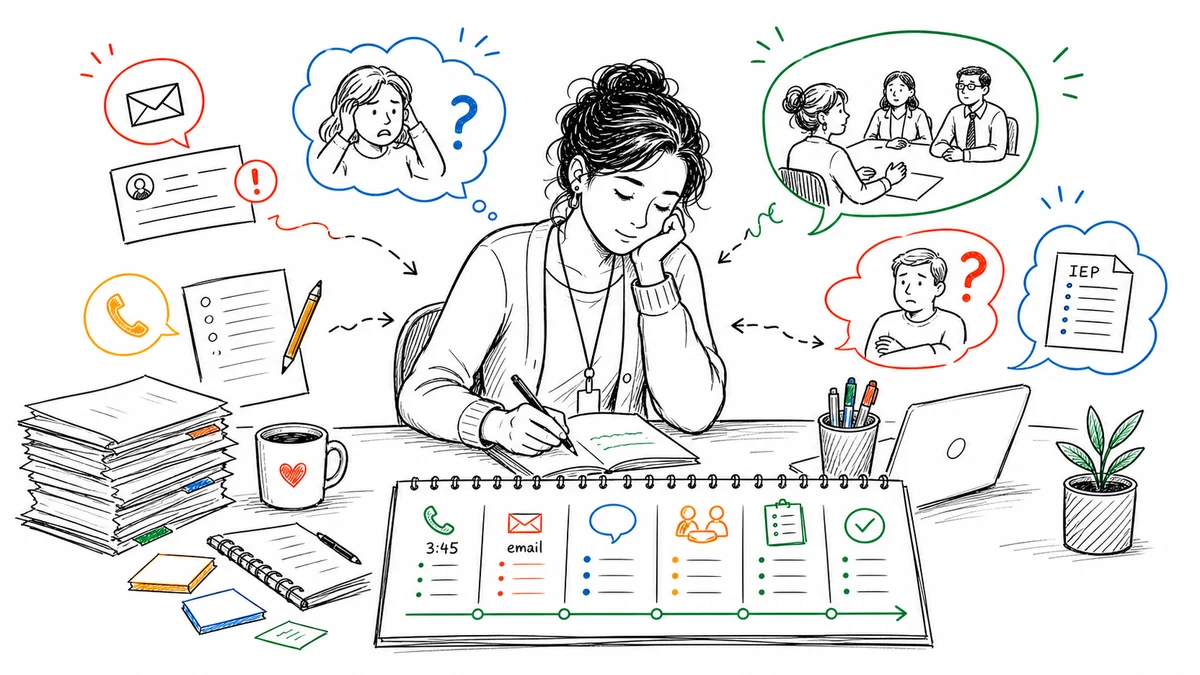
This guide covers all of it: emails, phone calls, conferences, IEP meetings, documentation, and the situations that keep teachers up at night.
Writing behavior emails to parents
The blank screen problem is real. You know you need to reach out, but finding the right words when you are tired and emotionally drained is genuinely hard.
The key is structure. A good behavior email has five parts: a brief warm opener, a specific description of what happened (what, when, where), the context around it, what you are already doing to help, and an invitation for the parent to respond. Under 150 words. Calm and factual even when the situation is not.
For copy-paste ready scripts you can send tonight, see 5 Sample Emails to Parents About Student Behavior.
If you want to understand the underlying approach, How to Write Behavior Emails to Parents walks through the structure in more detail.
One of the hardest emails to write is the one where you need to tell a parent their child is being disruptive. The framing matters. How to Tell Parents Their Child Is Disruptive covers how to name the behavior without putting parents on the defensive.
Making the phone call
Some situations need a call, not an email. Emotional conversations, escalating patterns, anything that could be misread in writing.
The challenge is that most teachers have not been given a script. You pick up the phone and improvise, which is where things can go sideways.
The Ultimate Parent Phone Call Script for Teachers gives you a word-for-word framework for both positive calls and difficult behavior conversations.
Before you dial, How to Politely Tell Parents Their Child Is Misbehaving covers the specific phrases to use (and the ones to avoid) when the conversation gets uncomfortable.
After the call, send a brief written summary within 24 hours. It creates a shared record and reduces the chance of "I never heard about this" coming up later.
When parents do not respond
You have called twice. Emailed three times. Nothing.
This is more common than it should be, and it puts teachers in a difficult position, especially when the student's behavior is escalating or an IEP meeting is approaching.
What to Do When Parents Don't Respond to Calls or Emails covers the specific steps to take and how to document your attempts clearly.
The short version: document every attempt with a date and method, try multiple channels, and loop in your administrator after three documented attempts with no response. You cannot force a parent to engage, but you can prove you tried.
When a parent says you never called
This one stings. Especially when you know you did reach out.
The problem is almost always documentation. If you cannot show a log with dates and communication methods, it becomes your word against theirs.
What to Do When a Parent Says You Never Called walks through how to handle the moment when it happens and how to build a documentation habit that prevents it from happening again.
The related issue is the contact record itself. How to Document Parent Contact as a Teacher explains what to record, how often, and what format actually holds up when things escalate.
A free template to get started: Free Parent Communication Log for Teachers.
Parent-teacher conferences
Conferences feel high-stakes because they are. You have 15 minutes, a parent who may be anxious or defensive, and a student whose school experience you are trying to describe accurately without causing panic.
The preparation phase matters more than most teachers realize. How to Prepare for a Parent-Teacher Conference covers what to pull together before you sit down: behavior notes, work samples, attendance patterns, and a clear picture of both strengths and struggles.
If behavior is the main concern, What to Bring to a Parent-Teacher Conference About Behavior covers the specific examples, pattern notes, parent contact records, and interventions to have in front of you.
For the actual conversation, What to Say at a Parent-Teacher Conference gives you the language for opening the meeting, naming concerns, handling a parent who gets defensive, and closing with a concrete next step.
If you need to write comments ahead of the conference, Parent-Teacher Conference Comments for Teachers has examples organized by common situations.
For a printable place to keep all of it, the free Parent Teacher Conference Form gives you one page per student, with sections to fill in before the meeting and room for parent input and an action plan during it.
IEP meetings and documentation
IEP meetings are a different kind of conversation. There are legal implications, multiple adults in the room, and often a parent who has been fighting for their child's needs for years. The pressure is real.
What to Say at an IEP Meeting covers how to present your observational data clearly, respond when a parent disagrees, and stay collaborative even when the meeting gets tense.
For preparation, IEP Meeting Checklist for Teachers breaks down exactly what to have ready before you walk in: before, during, and after.
Documentation is especially important in IEP contexts. How to Document Parent Contact for an IEP covers the specific records you need and how to keep them in a format that holds up.
Building a documentation habit
Before any of the conversations in this guide, there is one communication worth sending first. A welcome letter home at the start of the year sets the tone before problems arrive. If you need one, the Welcome Letter Generator builds a ready-to-send letter for your grade and tone in 30 seconds. Or see four real examples with notes on what makes each one work. For the app and WhatsApp version, there are 30 short welcome messages ready to paste. And if you are a new or mid-year teacher introducing yourself for the first time, start with the teacher introduction letter examples.
Everything in this guide is easier when you already have notes.
The teachers who feel most confident in difficult parent conversations are the ones who have been logging behavior and communication consistently. Not because they are paranoid. Because they do not have to rely on memory when a parent pushes back.
The documentation does not need to be complicated. A simple log with the date, what happened, and what was discussed is enough to shift the whole dynamic of a difficult conversation.
ShortHand is built around this exact problem. It lets you log a quick behavior note or parent communication in a few seconds, right from your phone, without switching apps or filling out forms. Over time, those notes become a timestamped record that has your back.
Try ShortHand free and see how much lighter parent communication feels when you are not starting from scratch every time.
Gregory Lebed is a former Registered Behavior Technician (RBT) and third grade teacher. He built ShortHand after spending too many parent meetings wishing he had written things down sooner.
Frequently Asked Questions
Stop trying to remember everything.
Try ShortHand Free →