How to Document Student Behavior From Day One (Before Problems Start)
The first month sets the standard. Here is how to build a documentation habit before you need one.
Every August, teachers spend hours organizing desks, hanging bulletin boards, and preparing lesson plans. We think about classroom expectations, procedures, and routines.
Very few of us think about documentation.
That is a mistake.
Most behavior problems do not appear overnight. They develop slowly. A student who struggles with transitions in October often showed signs in September. A student who begins missing assignments in November may have displayed warning signs during the first few weeks of school.
The challenge is that by the time a problem becomes serious, our memory is often incomplete.
When a parent asks, "Has this been happening all year?" or an administrator asks for examples, we are left trying to reconstruct events from memory.
The best time to start student behavior documentation is not after a problem starts.
It is before one starts.
The Mistake I Made
One of the biggest surprises I experienced as a classroom teacher was realizing how much I forgot by the end of the day.
Leading a 3rd grade class, things were happening too quickly for me to process everything in the moment. I would jot something down on a sticky note, tell myself I would follow up with the student later, and then discover the details had already become fuzzy.
A single student behavior does not seem important when it happens. Neither does a quick parent conversation in the hallway. Or a moment when a student refuses to begin an assignment.
But when you have twenty or more students and seven hours of teaching, those moments add up fast.
I would reach the end of the week knowing that something had happened multiple times, but I could not always remember exactly when, how often, what preceded it, what followed it, or what I had already communicated to families.
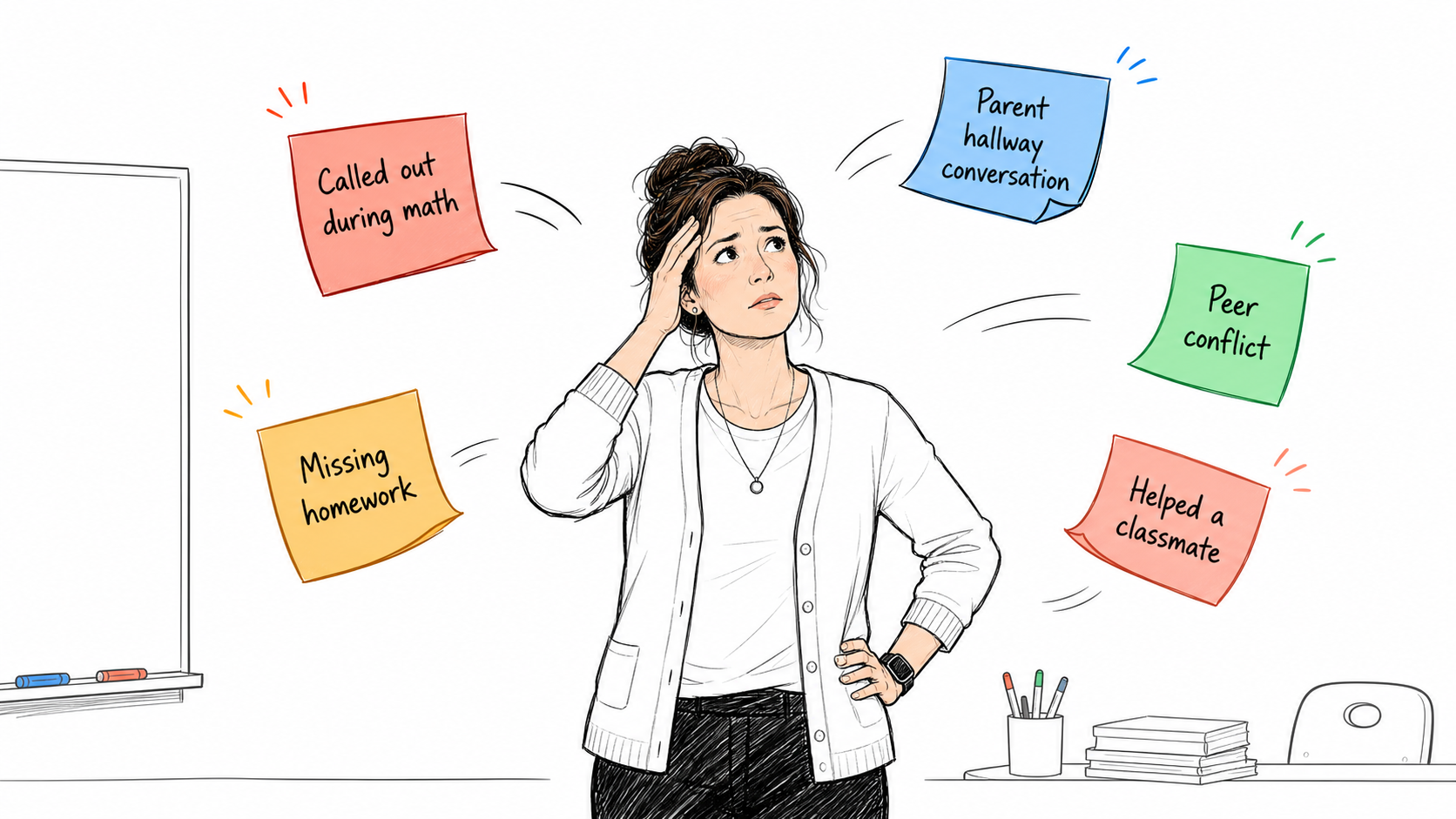
It did not take long for me to realize something important:
Memory is not a system. Documentation is.
If you have ever reached Friday afternoon and realized you cannot remember exactly what happened on Monday, you are not alone.
That is why I built ShortHand.
Keep behavior notes, parent communication records, and student documentation organized in one place.
Effective student behavior documentation gave me something memory never could: a reliable record of what was actually happening in my classroom.
Students are quick to recognize which expectations are consistently enforced and which ones are not. Once that pattern develops, it can be difficult to reverse.
The beginning of the school year is the most important time to set the standard. Students deserve to know that their teacher is paying attention, following through, and creating a classroom where expectations matter.
If you want a deeper look at how to build this habit into your daily routine, the teacher behavior documentation guide covers the full system.
What Should Teachers Document During the First Month?
You do not need to record every minor behavior.
Focus on patterns.
Most students will have a bad moment, or even a bad day, from time to time. That is normal. The goal is not to document every mistake. The goal is to identify behaviors that happen repeatedly.
With proper records, you can see those patterns objectively instead of relying on your feelings or memory.
Here are some of the most useful things to track when building a student behavior documentation system during the first few weeks of school.
Frequent Redirections
Students who consistently need reminders often reveal patterns early.
Examples include:
- Calling out
- Leaving their seat
- Off-task behavior
- Difficulty following directions
- Interrupting peers
One isolated incident means very little.
Repeated incidents tell a story.
Missing or Incomplete Work
The first month establishes academic habits.
Track students who:
- Frequently forget assignments
- Leave work unfinished
- Avoid independent tasks
- Need repeated prompting to begin work
These patterns often become important later in the year.
Peer Interactions
Positive and negative social behaviors both matter.
Document students who:
- Frequently help others
- Demonstrate leadership
- Experience repeated conflicts
- Struggle with teamwork
Many future behavior concerns begin as small social patterns.
Parent Communication
Every contact matters.
Keep brief notes about:
- Welcome phone calls
- Parent questions
- Behavior conversations
- Academic concerns
- Positive updates
A free parent communication log can help you keep these contacts organized from the start of the year so nothing falls through the cracks before conference season. If you have not sent a welcome letter yet, that is the first contact worth making: the Welcome Letter Generator takes 30 seconds and sets the tone before any of the harder conversations arrive.
Positive Behaviors
Documentation should not only focus on problems.
Track students who:
- Show leadership
- Demonstrate kindness
- Take initiative
- Improve significantly
- Help classmates
Positive patterns are often just as important as negative ones.
A Simple Documentation System
Many teachers fail to document because they believe it requires lengthy notes.
It does not.
A useful note can be as simple as:
"9/12 - Needed three reminders to begin independent work."
Or:
"9/14 - Helped a new student learn classroom procedures."
The goal is not to write a novel.
The goal is to create a record.
Small notes collected consistently become meaningful data over time. If you prefer a structured format to get started, a teacher documentation log template gives you a ready-made system you can use on day one.
Why Starting Early Matters
Documentation becomes most valuable when memories begin to fade.
Good student behavior documentation is not about catching students doing something wrong. It is about identifying patterns, communicating clearly with families, and making informed decisions based on facts instead of memory.
Months from now, you may need to answer questions like:
- When did this behavior start?
- How often has it happened?
- Have parents been informed?
- What interventions have already been attempted?
Teachers who document early can answer those questions confidently.
Teachers who wait often find themselves relying on memory.
And memory is rarely as accurate as we think.
For a closer look at how documentation holds up in formal settings, the IEP behavior documentation checklist walks through what records matter most when a student moves toward a more structured support plan.
Final Thoughts
The first month of school is not just about building routines for students.
It is about building systems for yourself.
Future parent meetings, conferences, behavior discussions, and intervention plans all become easier when you have a consistent student behavior documentation system and a clear record of what actually happened.
Start small.
Document patterns.
Focus on consistency.
Your future self will thank you.
Once conference season arrives, those notes become even more valuable. Here is what I recommend bringing to a parent-teacher conference about behavior.
The same documentation habit applies if you work summer school. The first week of ESY is when you collect some of the most useful information of the whole session. Here is what I document for every student during the first week of summer school.
Frequently Asked Questions
Stop trying to remember everything.
Try ShortHand Free →