Preschool Report Card Comments: 60+ Examples for Pre-K Progress Reports
Copy-paste comments for social skills, early academics, motor skills, and independence, plus what to write for your 3-year-olds and 4-year-olds.
Writing progress reports for preschool-age kids is its own kind of hard. What do you even say about a 4-year-old? "Shows strong emerging scissor skills"? "Continues to develop as a snack-time citizen"?
Before I taught 3rd grade, I spent years working with young children as a Registered Behavior Technician, and progress notes were a daily part of that job. The lesson that stuck with me: parents of little kids do not want jargon. They want proof that you actually know their child.
Every comment below is built to do exactly that. They are organized by developmental domain, so grab what you need, swap in a name, and adjust the details to match the actual kid. The same comments work whether your school calls these preschool report cards, Pre-K progress reports, or daycare and nursery progress notes.
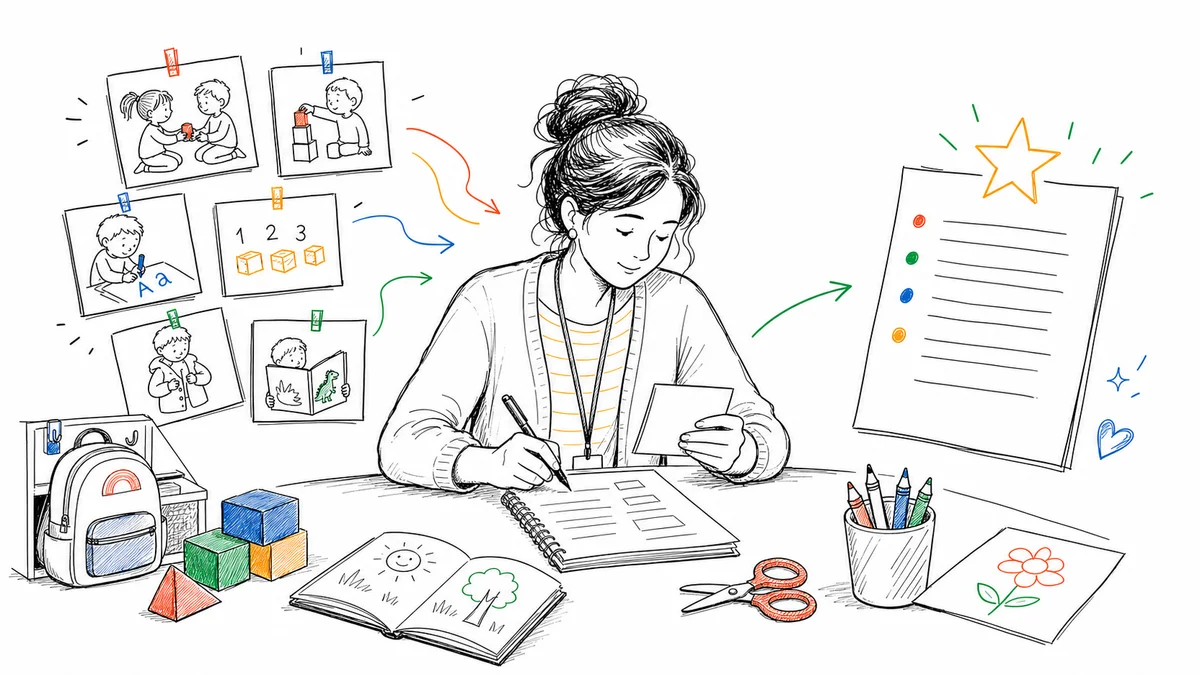
If you're looking for behavior-focused language, routines, transitions, or self-regulation comments, we have a dedicated post: preschool behavior report card comments. This page sticks to development, academics, and general growth. And if reports are due tonight, the free report card comment generator builds a polished comment in seconds with no sign-up.
The formula that makes preschool comments easy
Every comment on this page follows the same three-part structure:
- Something the child can do now (specific, observable)
- The skill they are building next
- A detail the parent would recognize (optional, but this is what makes a comment feel personal)
Preschool reports are progress reports, not report cards in the graded sense. You are describing a moving picture, not assigning a score. Keep that frame and the writing gets much easier.
Social skills and friendships
Social growth is the heart of preschool. If your report card has a dedicated social-emotional section, our social emotional report card comments go deeper on that language.
- "[Name] has formed warm friendships this year and often greets classmates by name at arrival. They are learning to invite others into their play rather than waiting to be asked."
- "[Name] loves group activities and is a frequent volunteer during circle time. We are practicing waiting for a turn to speak, and they respond well to a gentle visual reminder."
- "[Name] is a kind and observant classmate who notices when a friend is upset. They are building the words to offer help, and it is lovely to watch."
- "[Name] prefers playing alongside classmates rather than with them, which is developmentally right on track. We are gently encouraging shared play through partner activities they enjoy."
- "[Name] has grown from parallel play into true cooperative play this year. Their pretend kitchen restaurant now has regular customers."
- "[Name] shares materials willingly and often offers supplies to classmates during art projects before being asked."
This page covers development and academics for Pre-K. If you also need the behavior side, or want everything in one searchable place: The Report Card Comment Library is built to get you to the right comment in seconds instead of scrolling a long list. Search every comment by keyword, or filter by section, category, tone, and grade band to quickly find one that fits the student you’re writing about.
Type the student’s name once and it drops into every comment. Copy the one that fits, then move to the next student.
374 comments, organized by section and category. One-time $4.99, no subscription.
Looking for behavior, routines, or self-regulation comments?
Comments about classroom routines, transitions, calm-down strategies, and self-regulation live on our dedicated preschool behavior report card comments page. This page focuses on development and academics; that one covers behavior and emotional growth.
Language and early literacy
- "[Name] loves story time and often predicts what will happen next. They retell familiar stories with impressive detail during dramatic play."
- "[Name] recognizes their own name in print and is beginning to identify several classmates' names on our sign-in chart."
- "[Name] can identify most uppercase letters and is starting to connect letters with their sounds. The letter of their first name was, of course, the first one mastered."
- "[Name] speaks in full sentences and is building the confidence to share ideas with the whole group, not just with trusted adults."
- "[Name] enjoys rhyming games and can produce their own rhymes, real words and delightfully invented ones alike."
- "[Name] is holding books correctly, turning pages one at a time, and telling the story from the pictures. These are exactly the pre-reading habits we want to see."
- "[Name] listens attentively during read-alouds and answers questions about what happened in the story. Their comprehension is strong for this age."
- "[Name] is beginning to write the first letter of their name independently and traces the remaining letters with support."
Early math and thinking skills
- "[Name] counts objects accurately to ten and is working on counting past thirteen, which trips up nearly every four-year-old."
- "[Name] sorts objects by color, size, and shape and enjoys explaining the rule they used. Their sorting explanations are a highlight of my day."
- "[Name] recognizes and extends simple patterns and has started creating original patterns with blocks and beads."
- "[Name] uses comparison words like bigger, smaller, more, and less correctly during play. Snack-time negotiations have made this skill very strong."
- "[Name] is beginning to understand one-to-one correspondence, touching each object once while counting. This is a foundational math skill and it is coming along beautifully."
- "[Name] recognizes the numerals one through five and matches them to sets of objects during math centers."
Fine and gross motor skills
- "[Name] holds crayons and markers with a developing tripod grasp and is starting to draw recognizable shapes and people."
- "[Name] uses scissors with growing control and can cut along a straight line. Curved lines are our next adventure."
- "[Name] is confident on the climbing structure and has mastered the balance beam, feet alternating and arms out like a tiny gymnast."
- "[Name] can write some letters of their name and is building the hand strength for more. Playdough time is doing quiet, important work here."
- "[Name] manages zippers and buttons with increasing independence and is very proud of it, as they should be."
- "[Name] runs, jumps, and climbs with confidence during outdoor play and is learning to pump their legs on the swings."
Independence and self-help
- "[Name] manages their own belongings at arrival and dismissal, and their backpack routine is fully independent."
- "[Name] is learning to try tasks before asking for help. Their new phrase, 'let me try first,' has been wonderful to hear."
- "[Name] serves themselves at snack, cleans their space, and often reminds tablemates of the routine. A natural leader in the making."
- "[Name] asks for help clearly and appropriately when a task is genuinely too hard, which is exactly the self-advocacy skill we want at this age."
- "[Name] puts on their own coat independently and is mastering the zipper. They light up every time it works on the first try."
- "[Name] handles hand-washing and bathroom routines independently and follows our snack routine without reminders."
Work habits and approaches to learning
- "[Name] settles into activities quickly and stays with a task from start to finish. Their focus during center time has grown noticeably this year."
- "[Name] is a persistent problem solver who tries several approaches before asking for help. Puzzles are a particular favorite."
- "[Name] shows genuine curiosity during discovery activities and asks thoughtful questions about how things work."
- "[Name] approaches new activities with enthusiasm and is often the first to try something unfamiliar."
- "[Name] is building the stamina to stay with challenging tasks a little longer each week. We celebrate every completed project."
- "[Name] takes pride in finished work and enjoys sharing projects with the class. They are learning to describe the steps they used to make them."
Areas for growth
Every honest report names at least one skill still in progress. The pattern that keeps these comments from alarming parents: name the skill, describe the classroom support, and offer one thing to try at home.
- "[Name] is building stamina for seated activities and currently does best in short, focused stretches. We are gradually extending that time together."
- "[Name] is working on letter recognition and making steady progress. Extra practice with the letters in their name at home would be a great support."
- "[Name] is developing scissor skills and hand strength. Activities like playdough, tweezers, and lacing cards at home would build those same muscles."
- "[Name] is working on counting accurately past five. Counting real objects together at home, like stairs or snack crackers, reinforces what we practice at school."
- "[Name] is building the confidence to speak loudly enough for the whole group to hear. In small groups their ideas are wonderful, and we are working on sharing them more widely."
- "[Name] is learning to try new activities outside their comfort zone. We offer choices and celebrate every brave attempt."
Comments for 4-year-olds
Four-year-olds are on the runway to kindergarten, so reports for this age can lean a little more academic while staying warm. These highlight the readiness skills parents are watching for.
- "[Name] is showing real kindergarten readiness this year: recognizing letters, counting with confidence, and following multi-step directions during centers."
- "[Name] loves being a helper and often chooses jobs that require responsibility, like line leader or calendar helper. That sense of ownership will serve them well in kindergarten."
- "[Name] asks thoughtful questions and is beginning to make predictions during read-alouds, a skill that will carry them far as a reader next year."
- "[Name] works with growing independence on multi-step tasks, from cleanup routines to art projects with several steps. Kindergarten will be a great fit for that focus."
- "[Name] has grown more confident sharing ideas with the whole group this year, a big shift from the quieter mornings of September."
- "[Name] is developing early writing skills, from letter formation to using pictures and labels to tell a story. We are excited to see where that curiosity takes them next year."
Comments for 3-year-olds
Reports for the youngest preschoolers should feel even softer. You are reassuring the parent that their child is settling in, growing, and known. Keep the focus on comfort, curiosity, and play. These work just as well for daycare and nursery progress notes.
- "[Name] has settled into our classroom beautifully and now separates from caregivers with a wave and a smile most mornings."
- "[Name] is a curious explorer who moves through every center in the room. Water table days are their favorite, without question."
- "[Name] is beginning to use words to express wants and needs instead of gestures. Their vocabulary grows every single week."
- "[Name] enjoys singing our classroom songs and does all the hand motions, sometimes for the whole ride home, I am told."
- "[Name] is learning to sit with the group for short stretches during story time, and those stretches get a little longer every month."
- "[Name] is beginning to play near other children and sometimes hands a toy to a friend. These are the first steps toward sharing, right on schedule."
- "[Name] knows our daily routine and anticipates what comes next, often heading to the rug before the cleanup song even ends."
End-of-year comments
- "[Name] has grown so much this year, from a quiet observer in September to a confident friend who leads games at recess. It has been a privilege to watch."
- "[Name] is ready for the next step. They follow routines independently, ask wonderful questions, and take care of their classmates. Kindergarten is lucky to get them."
- "[Name] has grown in every domain this year: friendships, confidence, early academics, and independence. We are so proud of the learner they are becoming."
- "[Name] leaves us counting, rhyming, and negotiating turn-taking like a pro. They are more than ready for whatever comes next."
- "Thank you for sharing [Name] with us this year. Their curiosity, humor, and kindness made our classroom better every day."
What not to write
A few things I learned the hard way, first as an RBT writing daily notes and later as a teacher:
- No diagnoses or diagnostic-sounding language. You may suspect something. The report card is not the place. That conversation happens in person, with support staff involved.
- No comparisons to classmates. "Behind the rest of the class" helps no one at this age. Compare the child to their own September self instead. If a concern is real, our guide to writing honest behavior comments covers how to say it without softening it into meaninglessness.
- No surprises. If a parent learns about a concern for the first time on a progress report, the report has failed. Call first, write second.
The real secret: notes you took months ago
Here is the honest problem with every list like this one. The comments only feel personal if you remember the actual kid: the pretend restaurant, the water table afternoons, the "let me try first." And by report time, most of those details have evaporated.
The teachers who write the best preschool comments are not better writers. They just kept notes. Even one sentence a week per child gives you more material than you can use. Our teacher's guide to documenting student behavior covers how to build that habit without adding another job to your plate.
That is also exactly why I built ShortHand. You log a ten-second note on your phone in the moment ("M. shared her pretend restaurant with three friends today"), and at report time every note is right there, sorted by child. The specific, warm, personal comment writes itself, because you already wrote it back in October.
Try ShortHand free and let your own notes do the heavy lifting. Or if report cards are due this week, the free report card comment generator will get you through tonight.
Gregory Lebed is a 3rd grade teacher with 20+ years in education and a former Registered Behavior Technician. He built ShortHand to help teachers spend less time on paperwork and more time teaching.
Frequently Asked Questions
Stop trying to remember everything.
Try ShortHand Free →