Social Emotional Report Card Comments: 50 Examples for Self-Regulation, Social Skills, and Confidence
The comments teachers struggle with most, written out: honest, specific, and safe to send home.
You can knock out the math comments in an afternoon. Reading, fine. But then you hit the box for "demonstrates self-control" next to a kid who flipped a chair in October, cried through November, and has been slowly, genuinely getting better ever since. What do you put there?
That box is where report card writing actually gets hard. Say too little and the parent learns nothing. Say it wrong and you have labeled a seven-year-old in a permanent school record.
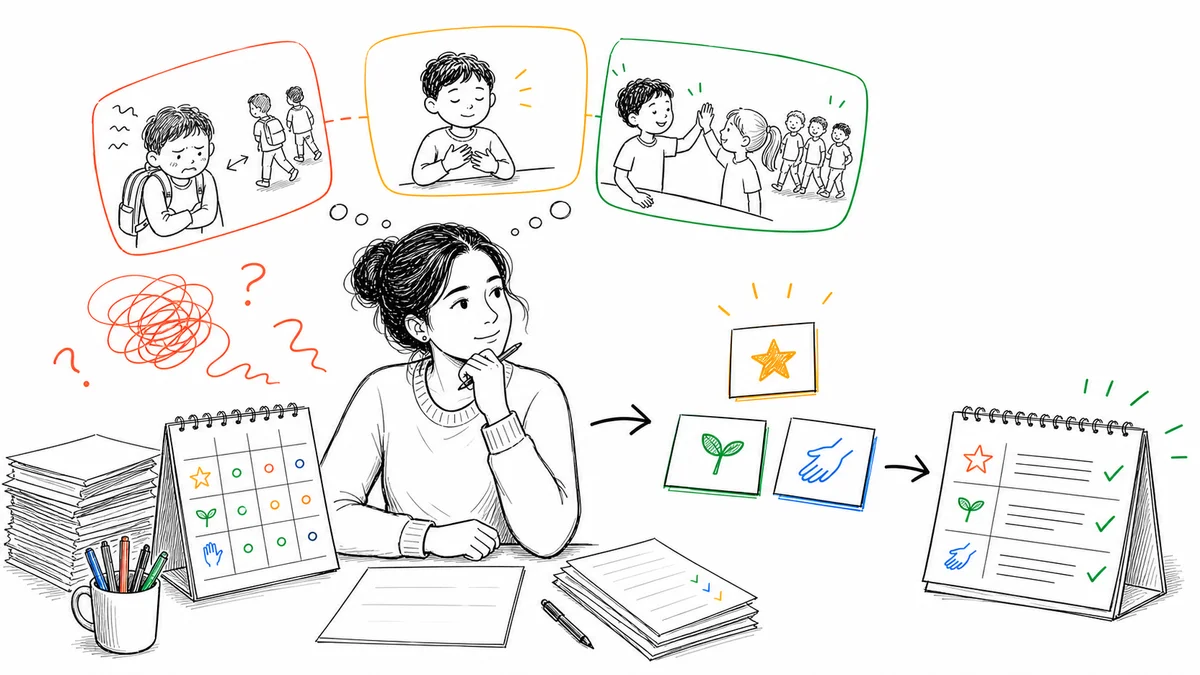
I spent years as a Registered Behavior Technician before I became a classroom teacher, which means I have written thousands of notes about exactly these skills: regulation, peer interaction, frustration tolerance. The one rule that carried over from that work to report cards: describe the behavior, never the child.
These 50 comments all follow that rule, and they work whatever your report card calls this section: social emotional learning (SEL), habits and attitudes, or learner qualities. Swap in the name, adjust the details, and they are ready to send.
The three-part formula
Every comment here is built the same way:
- A genuine strength or bright spot (parents hear everything that follows through this)
- The skill being built, described as in-progress, not missing
- The support that is working, so the parent knows the school has a plan
The formula matters more than the examples. If none of these fit your student, build your own from those three parts and it will land.
Two related guides in case this is not quite the section you are writing: for the general behavior box, our report card comments for behavior has 120+ examples, and if you teach Pre-K, the preschool report card comments use softer developmental language for 3-5 year olds.
Self-regulation report card comments
The hardest box on the card for most teachers. These cover big feelings, transitions, flexibility, and frustration tolerance:
- "[Name] is developing strong self-awareness and can now name when they are becoming frustrated. Asking for a water break has become their go-to strategy, and it works."
- "[Name] brings great energy to our classroom and is learning to channel it during quiet work times. Movement breaks and a wiggle cushion have made a real difference."
- "[Name] has made steady progress managing disappointment when things do not go as planned. Recovery time that used to take most of a lesson now takes a few minutes."
- "[Name] is learning that big feelings are okay and that there are safe ways to express them. They are beginning to use our calm-down space independently, which is exactly the goal."
- "[Name] transitions between activities much more smoothly than earlier in the year. A two-minute warning continues to be the key, and they now sometimes give themselves one."
- "[Name] is building patience during moments of waiting, which is genuinely hard work at this age. We celebrate every successful turn-taking moment, and there are more of them every week."
- "[Name] handles unexpected schedule changes with increasing flexibility. This was a significant challenge in the fall and is now a real strength."
- "[Name] uses deep breathing and counting to calm down when frustrated, strategies they learned this year and now apply without prompting."
- "[Name] is learning to notice the early signs of frustration before they grow. Naming the feeling out loud has been the strategy that works best."
- "[Name] stays calm during partner and group work, even when the group disagrees. That flexibility has grown noticeably since the fall."
- "[Name] is working on settling back into learning after exciting moments like recess and assemblies. A short reset routine at their desk is helping."
- "[Name] is learning to keep a calm voice and body when excitement runs high. They respond immediately to our quiet signal and often model it for others."
These 50 comments cover social-emotional growth. The Report Card Comment Library is built to get you to the right comment in seconds instead of scrolling a long list. Search every comment by keyword, or filter by section, category, tone, and grade band to quickly find one that fits the student you’re writing about.
Type the student’s name once and it drops into every comment. Copy the one that fits, then move to the next student.
374 comments, organized by section and category. One-time $4.99, no subscription.
Peer relationships and social skills
- "[Name] is a loyal and caring friend who is learning to widen their circle. We are encouraging them to include new classmates in games, and they are trying."
- "[Name] loves to lead and has wonderful ideas for group play. They are learning that leaders also take turns following, and they respond well to gentle reminders."
- "[Name] is developing the skill of joining a game in progress by asking rather than jumping in. Our small-group practice sessions have helped this click."
- "[Name] works cooperatively in groups and has become someone classmates ask to be partnered with. That reputation was earned through real growth this year."
- "[Name] is learning to read how classmates are feeling and adjust. Last month they noticed a friend sitting alone at lunch and invited them over, completely unprompted."
- "[Name] prefers one or two close friendships to large groups, which suits them well. We are making sure they also have the skills to work with any classmate, and they do."
- "[Name] is practicing personal space awareness during rug time and lines. A visual spot marker has helped, and they now find their space independently."
Empathy and kindness
- "[Name] shows genuine concern when a classmate is hurt or upset and is often the first to offer help."
- "[Name] is developing empathy in real time: they have started asking 'are you okay?' before an adult prompts them, which is a milestone worth celebrating."
- "[Name] treats classroom materials, spaces, and people with care. They are the student who straightens the book bin without being asked."
- "[Name] is learning that words can hurt even when meant as jokes. We have worked on checking how a joke landed, and they are taking that responsibility seriously."
- "[Name] celebrates classmates' successes, which is rarer and more valuable than it sounds. When a tablemate finally mastered their multiplication facts, [Name] cheered the loudest."
Confidence and self-advocacy
- "[Name] has grown from whispering answers to sharing ideas with the whole class. Their hand is up every day now, and their contributions are thoughtful."
- "[Name] is learning to ask for help as a strength rather than a defeat. They now come to my desk with specific questions instead of sitting quietly stuck."
- "[Name] speaks up when something feels unfair, and is learning to do so respectfully. This is self-advocacy taking root, and we are shaping it, not squashing it."
- "[Name] takes on challenges willingly, even in areas that are hard for them. Watching them volunteer to read aloud this spring was a highlight of my year."
- "[Name] is building a growth mindset around mistakes. 'I can't do it yet' has replaced 'I can't do it,' and that one word is doing a lot of work."
- "[Name] handles feedback with increasing openness and often applies it immediately. This skill will serve them for the rest of their life."
Conflict resolution
- "[Name] is learning to solve small conflicts with words before involving an adult. Our class problem-solving steps have become part of their toolkit."
- "[Name] can now step away from a brewing conflict to cool down, then return to solve it. That sequence took months of practice and it shows real maturity."
- "[Name] is practicing seeing the other side of a disagreement. Role-playing both parts of a conflict has helped this skill grow."
- "[Name] apologizes sincerely and, more importantly, changes the behavior afterward. That follow-through is the part that counts, and they have it."
- "[Name] is learning the difference between tattling and reporting, and now comes to adults for the right reasons at the right times."
When there is a real concern
Sometimes "developing" is not the honest word. Sometimes the skill is genuinely not there yet and the parent needs to know. These comments stay honest without labeling:
- "[Name] is working hard on managing frustration during academic tasks. When work feels too difficult, they sometimes shut down or push materials away. We are using shorter task chunks and check-ins, and we would love to partner with you on strategies that help at home."
- "[Name] is still building the skills to resolve peer conflicts without physical responses. We take this seriously and have a consistent plan in place, including practicing replacement strategies daily. Progress is happening, and we will keep you closely updated."
- "[Name] often chooses to work and play alone, and we want to make sure that is a preference rather than a barrier. We are providing low-pressure partner opportunities and watching closely."
- "[Name] finds losing games and making mistakes very difficult, and reactions can be intense. We are teaching specific coping strategies and celebrating every calm recovery. This is our top social-emotional priority for the coming term."
- "[Name] is learning to respect classmates' personal space and belongings, with adult support still needed most days. We have a plan, we are consistent, and we would welcome a conversation about what you see at home."
Notice what those five comments never do: guess at a cause, use diagnostic language, or compare the child to classmates. If a concern is big enough that you are choosing words this carefully, it is big enough for a phone call before the report goes home. Our guide on how to write honest behavior comments goes deeper on getting that balance right, and if the conversation needs to happen by email first, these sample emails to parents about student behavior will save you a draft or three.
Growth-over-time comments
- "[Name]'s social-emotional growth is the story of their year. September's daily struggles are now occasional bumps, handled with strategies they chose themselves."
- "[Name] has transformed as a classmate this year: more patient, more flexible, and more generous. The work they put into this growth was real, and it shows."
- "[Name] ends the year with a full toolbox: they can name feelings, ask for breaks, solve small conflicts, and bounce back from disappointment. I am proud of every one of those skills."
- "[Name] needed a lot of adult support in the fall and now needs almost none. That independence is the single best predictor of a strong start next year."
- "[Name] taught our class something about perseverance this year. The skills that came hardest are now the ones they demonstrate best."
Quick strength lines to pair with any comment
- "is a kind and steady presence in our classroom"
- "brings humor and warmth to our class community"
- "is the classmate others turn to when they need help"
- "makes our classroom a better place to be"
- "has a genuine gift for making others feel included"
If you are writing more than a couple of students, the Report Card Comment Library has 374 comments you can search and filter, with the student name filled in. One-time $4.99.
Where the specifics come from
The difference between "demonstrates growth in self-regulation" and "recovery that used to take a lesson now takes a few minutes" is not writing talent. It is whether you have notes.
Social-emotional growth is slow and quiet. Nobody remembers in June that the chair-flipping stopped in January unless it got written down in January. A one-line note in the moment is all it takes, and our teacher's guide to documenting student behavior shows how to make that a habit that survives a real school year.
These comments also work for mid-term check-ins. If you are writing progress reports rather than report cards, the student progress report comments for teachers collection covers that shorter format.
If you still have most of a class to get through, that is what the Report Card Comment Library is for. 374 comments across behavior, ADHD and attention, preschool, academics, and social-emotional, all searchable and filterable, with the student name filled in automatically. You are not scrolling a blog post and swapping the name in by hand. One-time $4.99, and you can try a sample of it before you buy.
Need one comment right now with no purchase? The free report card comment generator writes a single comment. If you have a whole class left, use the library.
Worth knowing for next term: the reason a comment like "recovery that used to take a lesson now takes a few minutes" is possible at all is that somebody wrote it down in January. ShortHand is a ten-second note on your phone when it happens, sorted by student, waiting for you at report card time.
Gregory Lebed is a 3rd grade teacher with 20+ years in education and a former Registered Behavior Technician. He built ShortHand to help teachers spend less time on paperwork and more time teaching.
Frequently Asked Questions
Stop trying to remember everything.
Try ShortHand Free →