Positive Report Card Comments for Struggling Students (That Stay Honest)
How to write comments that give parents hope without hiding the truth, with 35 examples by subject and situation.
There is a specific kind of dread that comes with opening the comment box for a student who is drowning. You know the parent will read this. You know the kid might read it someday. You know "needs improvement" is a cop-out and "significantly below grade level in all areas" reads like a verdict.
I have written that comment many times, and I have also been on the receiving end of report cards as a parent. So let me offer the frame that finally made these comments easier to write.
The parent of a struggling student is not looking for a grade. They already suspect. What they are looking for, reading your comment at the kitchen table, is the answer to three questions:
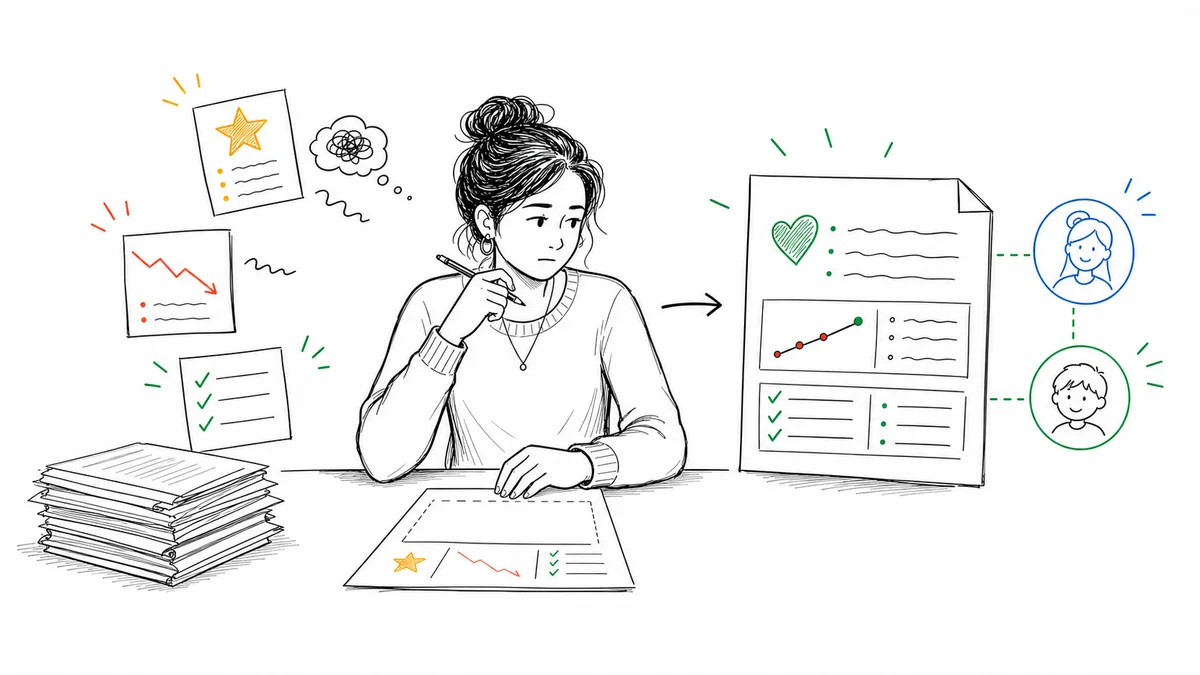
- Does this teacher see anything good in my kid?
- How bad is it, really?
- Is anyone doing anything about it?
Answer all three and you have written a great comment. Skip the first one and the parent stops reading. Skip the second and you have lied. Skip the third and you have handed them despair. Every example below answers all three.
Struggling readers
- "[Name] listens to read-alouds with real attention and has strong comprehension when text is read to them. Decoding is the current barrier: they are reading below grade level and work with me in a small group daily. Their sight word bank has grown steadily each month."
- "[Name] has not given up on reading, and that matters more than any score this term. They are working through our intervention program with genuine effort, and fluency is improving week over week, even though it is not yet where we want it."
- "[Name] shines during our class discussions of stories, offering ideas that show deep thinking. Getting those same ideas from the printed page is still hard work. We are targeting decoding daily, and I would love to talk about ways to keep reading low-pressure at home."
- "[Name] chose to reread a book from our intervention group during free reading last week, which tells me confidence is starting to grow alongside skill. Level-wise there is real ground to cover, and we have a plan for covering it."
Struggling writers
- "[Name] has wonderful ideas and tells detailed stories out loud. Getting those ideas onto paper is the current challenge. We are using sentence starters and a graphic organizer, and their drafts are growing longer each month."
- "[Name]'s spelling makes their writing hard to read right now, but it should not hide the strong voice underneath. We practice high-frequency words daily, and at home I encourage letting them write freely without corrections."
- "[Name] used to write two words and stop. They now produce several sentences with support, and our next goal is a full paragraph, guided by a simple checklist they helped design."
- "[Name] finds writing time stressful, so our first project has been lowering the stakes: shorter prompts, drawing before drafting, and celebrating every finished piece. The dread is fading and the output is rising."
Need to find the right one faster, across every category? The Report Card Comment Library is built to get you to the right comment in seconds instead of scrolling a long list. Search every comment by keyword, or filter by section, category, tone, and grade band to quickly find one that fits the student you’re writing about.
Type the student’s name once and it drops into every comment. Copy the one that fits, then move to the next student.
374 comments, organized by section and category. One-time $4.99, no subscription.
Struggling math students
- "[Name] has a strong sense of numbers in real-world contexts, especially anything involving money. Multi-step problems on paper are the current challenge, and we are breaking them into single steps with a checklist that is starting to work."
- "[Name] asks for help now instead of hiding confusion, which is the single most important change this term. Math facts remain slow, and we practice daily. The effort is fully there; the automaticity will follow."
- "[Name] is below grade level in math this term, and I want to be direct about that because [Name] is working too hard for it to be glossed over. Small-group instruction is in place, progress is measurable, and my goal for next term is specific and reachable."
- "[Name] understands new math concepts during the lesson but has difficulty holding onto them by the next week. We have added spiral review and a reference notebook, and retention is beginning to improve."
Work completion and organization
- "[Name] produces thoughtful work when they finish, and finishing is what we are working on. A visual checklist and shorter chunks have raised their completion rate noticeably since the fall."
- "[Name] wants to do well, and I see it clearly in one-on-one moments. Independent work time is where things fall apart, so we have moved their seat, shortened the tasks, and added check-ins. Each change has helped a little; together they are helping a lot."
- "[Name]'s backpack, desk, and folder have been our term-long project, and there is real progress to report: assignments are making it home and back at a much higher rate. This unglamorous skill will pay off everywhere."
- "[Name] starts strong and fades mid-task. We are building stamina gradually, and what used to be five focused minutes is now closer to fifteen. That trajectory is the headline."
Confidence and effort
- "[Name] has stopped saying 'I'm bad at this,' and that shift matters more than it sounds. The skills are coming along behind the confidence, exactly the order these things usually go."
- "[Name] takes academic risks now: raising a hand, trying the hard problem first, reading aloud. The scores do not yet show what these behaviors predict, but they will."
- "[Name] had a difficult start to the year and has quietly rebuilt since. Work habits, participation, and attitude have all turned around. Academics are following more slowly, and we will keep at it together."
- "[Name] shows up every day and tries every day, through material that is genuinely hard for them. I do not take that persistence for granted, and I hope you will celebrate it at home, because it is the foundation everything else gets built on."
Comments for students working below grade level
"Below grade level" is the phrase parents brace for, so it needs the same three answers wrapped around it: something good, the honest picture, and the plan.
- "[Name] is currently working below grade level in reading, and I want you to have the honest picture along with the plan: daily small-group instruction, a progress check every two weeks, and a folder of just-right books that comes home each Monday."
- "[Name] is working below grade level in both reading and math. We have prioritized reading first, because it unlocks everything else. Intervention is in place, and progress is being measured, not guessed at."
- "[Name] is closing the gap. They began the year well below grade level in [subject] and are now approaching it, the direct result of consistent intervention and their own daily effort."
- "[Name] succeeds with grade-level material when it is modified, and those supports are the reason for this term's progress. Our long-term goal is to fade them gradually as skills solidify."
- "[Name] is performing below grade-level expectations this term. The support team now includes [support staff or program], we meet regularly to review progress, and you will never be left guessing where things stand."
- "[Name] is below grade level in [subject], and their growth rate this term has been genuinely strong. They are learning quickly, from a starting point further back. Both of those facts belong on this report."
When effort is also the struggle
The hardest comment to write is for the student who is behind and not currently trying. Manufactured praise fails here. Find what is true, and be plain about the rest:
- "[Name] is capable of strong work, and I have seen flashes of it this term. Right now, effort is inconsistent, and the missing work is affecting every grade. I want to solve this with you rather than just report it: a short conference would be a great next step."
- "[Name] is well liked and often the first to help a classmate. Bringing that same energy to academic work is our current challenge. We have started a simple daily goal system, and the first week showed promise."
- "[Name] and I are still looking for the subject that lights them up, and I have not given up. In the meantime, we are holding a clear, consistent expectation for completed work, and I would value your partnership in holding it at home too."
Quick lines to open any comment
Every struggling student has something true and good to lead with. If you are stuck, one of these is usually honest:
- "brings a sense of humor that our classroom would be poorer without"
- "is unfailingly kind to classmates"
- "has excellent attendance and arrives ready to start the day"
- "cares deeply about doing well, even when the work is frustrating"
- "has grown in independence since the beginning of the year"
- "contributes ideas during discussion that raise the level of our class"
The phrases to avoid
A few translations, learned over many report card seasons:
- Instead of: "Weak student." Write: "Working below grade level in [specific skill]."
- Instead of: "Lazy" or "unmotivated." Write: "Effort is inconsistent, and we are working on it with [specific support]."
- Instead of: "Struggles with everything." Write: the two priority areas, with the plan for each. A comment naming everything fixes nothing.
- Instead of: "Doesn't care." Write: what you observe, not what you infer: "rarely completes independent work" is observable; "doesn't care" is a guess about a child's heart, and it is usually wrong.
If the struggle is primarily behavioral rather than academic, we have a full set of report card comments for behavior. And if the student has ADHD or you suspect attention is the root, the strength-based ADHD comment templates handle that specific wording challenge.
Write the phone call before the comment
One rule above all: the report card should never be breaking news. If a student is genuinely struggling, the parent hears it from your voice first. The mid-term progress report is the other place parents should see it coming; these student progress report comments are built for those check-ins. The comment then becomes easy, because it is just a summary of a conversation you have already had. If that call is the part you dread, this script for calling a parent about behavior adapts well to academic conversations too.
Where the specifics come from
Every strong example above leans on a detail: the reread intervention book, the fifteen minutes of stamina, the sight word bank growing monthly. You cannot conjure those in June. You can only write them down when they happen, and the teacher's complete guide to documenting student behavior shows how to make that a habit that survives a full year.
That is the entire idea behind ShortHand. A ten-second note on your phone in the moment ("finished the whole page independently, first time") becomes the raw material for report card comments, parent emails, and intervention documentation later. When it is time to write about a struggling student, you are not staring at a blank box trying to be fair from memory. Your own observations are right there, and they already tell the story: honestly, specifically, and with the progress visible.
Try ShortHand free. The kids who struggle deserve the best-written comments on the page. And if reports are due before you can build the note-taking habit, the free report card comment generator will draft one for you right now, no sign-up needed.
Gregory Lebed is a 3rd grade teacher with 20+ years in education and a former Registered Behavior Technician. He built ShortHand to help teachers spend less time on paperwork and more time teaching.
Frequently Asked Questions
Stop trying to remember everything.
Try ShortHand Free →