10 Strength-Based Report Card Comments for Students with ADHD
Write honest, professional, and growth-oriented comments that support your neurodiverse learners.
Writing these for a whole class? The Report Card Comment Library fills in each student’s name for you and lets you search 374 comments. Try 20 free with no sign-up. The full set is $4.99 once.
As a parent of a neurodiverse child, I've learned how much wording matters. I've read report card comments that helped me understand what was actually happening at school, and I've read comments that left me wondering what the teacher even meant. The difference between those two experiences had almost nothing to do with whether the concerns were real. It was the wording.
As a teacher and former Registered Behavior Technician, I know what phrases like "frequently off task" usually mean. As a parent, I know how rarely that translation lands the way the teacher intended.
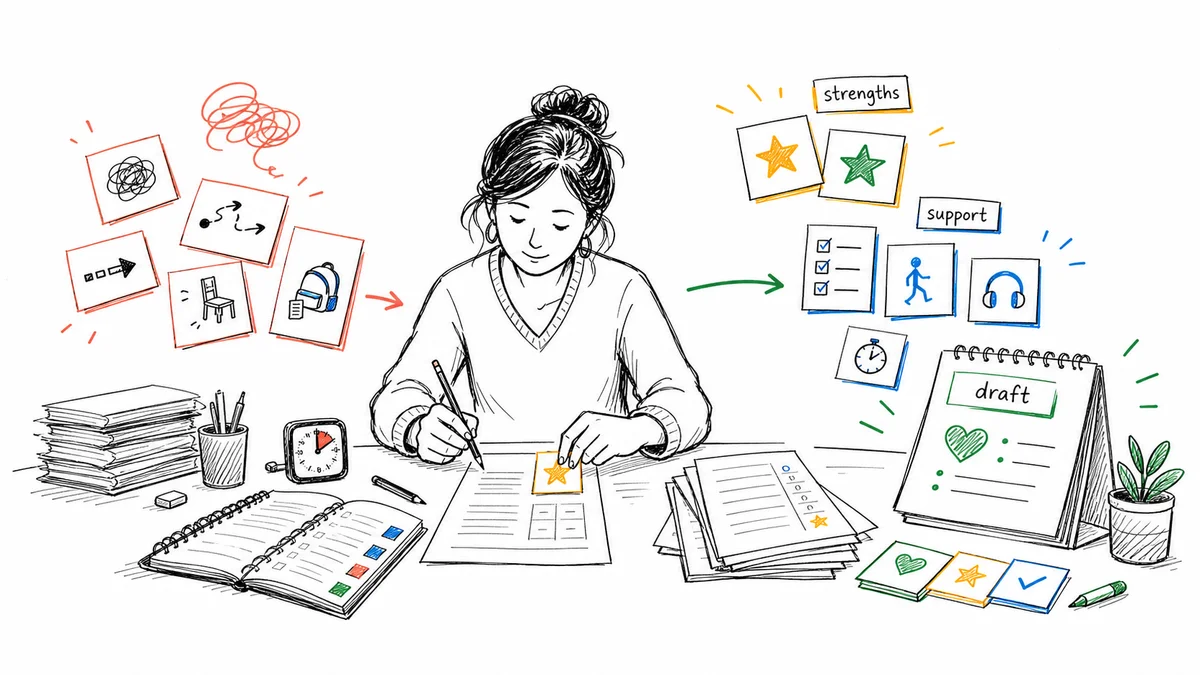
A student with ADHD is not simply choosing to be unfocused. ADHD can make attention regulation, task initiation, and impulse control much harder, especially during tasks that are lengthy, repetitive, or overwhelming. Report card language that treats those challenges as character flaws closes the door on the parent partnership you actually need. The comments below are built on observable behaviors, not judgments. They name what is happening and what the classroom is doing about it, which is what every parent of a neurodiverse kid is actually hoping to read.
Below are ten copy-and-paste comment templates that are honest, professional, and strength-based.
Why Strength-Based Comments Matter for ADHD
Many neurodiverse students receive a steady stream of corrections throughout the school day. By middle school, that feedback can shape how they see themselves as learners. Report cards should not just be a list of what they cannot do.
Lead with what the student does well, and the parent is more receptive to what comes next. Once you've established the strength, you can introduce the area of growth as a skill they're currently building, not a permanent deficit.
If you are looking to build a habit of sharing these wins throughout the term, check out our positive behavior email to parents template collection to establish strong partnerships early.
10 Report Card Comments for Students with ADHD
Here are ten templates categorized by the common areas we track on report cards. Replace the strategies and outcomes in each template with what you have actually observed. A strength-based comment should still be specific and accurate.
Focus and Attention Struggles
-
The Creative Thinker: "[Student] is a highly creative and enthusiastic learner who brings unique perspectives to our class discussions. While they can sometimes find independent tasks challenging to start, they benefit from using a visual checklist and verbal check-ins to stay focused on their daily assignments."
-
The High-Energy Participator: "[Student] brings wonderful energy and passion to our classroom. They are learning to manage distractions during instruction. They respond well to hands-on learning opportunities and quiet seating options that help them maintain focus."
-
The Progressing Focus: "[Student] has shown great effort in tracking their own focus this term. When they use their personalized timer, they are able to complete tasks independently. We will continue working on strategies to help them transition between activities smoothly."
Academic Effort and Work Habits
-
The Determined Learner: "[Student] demonstrates commendable persistence when tackling new academic concepts. They are working on breaking down larger projects into smaller, manageable steps. Having a designated quiet study space helps them produce their best work."
-
The Task Finisher: "[Student] is eager to complete their work and show what they know. Sometimes, their enthusiasm leads them to rush through assignments. We are working on a routine of slowing down and reviewing their work for detail before submitting it."
-
The Strategy User: "[Student] is learning to identify when they need a brief movement break to recharge. They are becoming more independent in utilizing these strategies, which has led to a noticeable improvement in the accuracy of their math work."
Looking for more ADHD-specific language, plus every other section? The Report Card Comment Library is a separate tool, built for getting through a whole class.
This page Free
- Scroll the list to find one that fits
- Swap in each student’s name yourself
- No sign-up
The library $4.99 once
- Type the name once and it fills into every comment
- Search by keyword, or filter by tone and grade band
- 374 comments: Behavior, ADHD / Attention, Preschool, Academics, Social-Emotional
No sign-up to try it. All 374 comments are a one-time $4.99, no subscription.
Social and Emotional Skills
-
The Collaborative Peer: "[Student] is a kind and empathetic classmate who works well in group settings. They are very enthusiastic about sharing their ideas. We are working on strategies to help them practice active listening and wait for their turn to speak during peer discussions."
-
The Resilient Friend: "[Student] has a great sense of humor and is a valued member of our classroom community. When faced with social conflicts, they are learning to use self-regulation strategies to manage their frustration and make positive choices."
Major Improvement and Turnaround
-
The Growth Milestone: "[Student] has made significant progress in their executive functioning skills this term. By using a daily binder organizer, they have drastically reduced the number of missing assignments. I am incredibly proud of their growth."
-
The Confidence Builder: "[Student]'s confidence has grown tremendously this quarter. They are advocating for their own learning needs by asking for clarification when directions feel overwhelming. This proactive approach is reflected in their excellent reading progress."
What NOT to Write on a Report Card
When writing report card comments for students with ADHD, it is vital to avoid vague, subjective, or pathologizing language.
Here are a few common phrases to avoid, along with what to write instead:
- Instead of: "Is lazy and refuses to do work." Write: "Benefits from tasks being broken down into smaller steps to prevent overwhelm."
- Instead of: "Distracts others and talks too much." Write: "Is working on choosing appropriate times to socialize and practicing active listening during instruction."
- Instead of: "Cannot sit still." Write: "Utilizes movement breaks and sensory tools to help regulate their energy level."
- Instead of: "Forgetful and disorganized." Write: "Is developing organizational routines and benefits from a daily checklist to track materials."
Vague complaints do not help the student or the parent. Clear, behavioral descriptions tell the family exactly what is happening and how to help.
For example, if a student is struggling with organization and forgetting work, you might want to look at how you communicate homework policies. You can reference our sample emails to parents about missing homework for ways to build a bridge between school and home organization.
How ShortHand Simplifies Your Report Card Season
Writing personalized, behavior-focused comments for neurodiverse students takes time. Without specific data points, you end up writing generic phrases that don't capture the student's actual progress.
This is where a digital log actually earns its keep.
ShortHand allows you to log specific student behaviors, accommodations used, and positive milestones in just a few seconds during the school day. When report card season arrives, you do not have to rely on memory or guess which strategies worked. If you do not yet have a logging habit in place, How to Document Student Behavior as a Teacher is a practical starting point for building one.
With ShortHand, you have a searchable timeline of exactly how a student responded to visual schedules, movement breaks, or reminders, so the comment you write reflects what actually happened, not what you can still remember in June.
Try ShortHand free and write report card comments from real classroom notes instead of relying on memory.
Still have most of your class to write? The Report Card Comment Library is built for getting through a whole class. Type a student’s name once and it fills into every comment, then search or filter to the one that fits and copy it.
No sign-up to try it. All 374 comments are a one-time $4.99, no subscription.
Stop trying to remember everything.
Try ShortHand Free →