Welcome Letter to Parents From Teacher: 4 Examples + Free Template
Real examples, a before/after, and the one mistake most teachers make.
Every August, I tell myself I am going to save last year's welcome letter somewhere obvious.
Every August, I fail.
So I end up opening an old document, deleting half of it, rewriting the other half, and wondering why I keep doing this to myself.
If you are getting ready for a new school year, a welcome letter is often the first thing families read from you. It sets the tone for your classroom, answers common questions, and starts building the parent-teacher relationship before the first issue ever comes up.
The good news is that a strong welcome letter does not need to be perfect. It just needs to be clear, friendly, and honest.
Below are four examples with notes on what makes each one work, including one letter I actually sent and what I would change about it today.
If you just need a letter done, the Welcome Letter Generator will build one for your grade and tone in about 30 seconds. If what you actually need is shorter or more specific, we also have 30 short welcome messages for class apps and texts and introduction letter examples for new and mid-year teachers. But if you want to understand what makes a welcome letter actually land with parents, keep reading.
What parents actually need from a welcome letter
Before the examples, a quick frame. Parents reading a welcome letter are asking four questions, usually without realizing it:
- Is my child going to be safe and happy?
- Does this teacher seem kind?
- How do I reach them if something comes up?
- What should we expect this year?
Everything else is nice to have. A letter that answers those four questions clearly and warmly has done its job.
Example 1: Warm elementary welcome letter
This is the style I use now. Personal without being a resume. Practical without being cold.
MEET YOUR 3RD GRADE TEACHER
Hello Third Graders and Families,
My name is Greg Lebed, and I am so excited to be your 3rd grade teacher this year. I cannot wait to get to know each of you.
A little about me: I grew up in South Jersey, earned my master's degree in elementary education, and spent more than 20 years working with students in schools and homes before landing in my own classroom. I have a 16-year-old daughter named Bella, which means I have been navigating homework battles from the parent side for a while now.
A few favorites, since we are going to spend a lot of time together:
- Drink: Coffee. A lot of it.
- Sports: Eagles, Sixers, Phillies. We can talk about this all year.
- Hobby: Playing Pokémon with my daughter. Yes, I am serious.
This year I am kind and fair, and I expect students to try their best and follow our classroom expectations. I love recognizing students who make good choices and work hard.
If you have a question or concern, please reach out through ParentSquare or email me at [your email]. I respond within 24 hours. For anything urgent, please contact the main office directly.
I am so excited for this year. Get ready for a great one.
Sincerely, Mr. Lebed
What works here: The favorites section is the most important part of this letter. Parents remember "Eagles fan with a 16-year-old" far longer than they remember a list of credentials. It makes you a person before you are a teacher. The communication instructions are specific, which eliminates follow-up questions.
Example 2: Professional welcome letter for upper elementary and middle school
For teachers who prefer a cleaner, more formal tone, or for upper elementary and middle school where the audience is a mix of parents and students who can read independently.
Dear Families,
My name is [Name], and I will be your child's [Grade/Subject] teacher this year. I am looking forward to working with your family throughout the school year.
A little about me: I have been teaching [grade level] for [X] years and am passionate about [one specific thing: building readers, making math make sense, creating a classroom where every student feels seen]. Before teaching, I [one sentence of relevant background if applicable].
Here is what you can expect from me this year:
- Consistent communication when something comes up, positive or negative
- A classroom where effort matters as much as results
- Quick responses to messages, usually within 24 hours on school days
The best way to reach me is [email or app]. For urgent matters, please contact the main office at [number].
I look forward to meeting you at Back to School Night and throughout the year.
Sincerely, [Name]
What works here: The three-bullet "what you can expect" section does something most welcome letters skip entirely. It tells parents what kind of teacher you are before they have to figure it out. That specificity builds trust faster than credentials.
Example 3: A Welcome Letter with Humor
Some teachers have a naturally funny voice, and trying to sound warm and professional just reads as stiff. If that is you, lean into it. This tone works best in elementary, where parents expect a little personality.
Dear Families,
A few things you should know about me before we get started:
I drink too much coffee. I lose my dry-erase markers at least twice a week. I get genuinely excited about classroom games, to a degree that some might call excessive.
Fortunately, I am much better at teaching than I am at keeping track of markers.
My name is [Name] and I will be your child's [grade] teacher this year. I have been teaching for [X] years, and every August I remember why I keep coming back: kids say things that make absolutely no sense, and somehow it all turns into learning by June.
Here is what I can promise you: your child will be in a classroom where effort is celebrated, mistakes are expected, and we figure things out together. I take that part seriously, even when I am pretending I know where my markers are.
The best way to reach me is [email or app]. I check messages daily and respond within 24 hours on school days.
Looking forward to a great year.
[Name]
What works here: The self-deprecating opener does two things at once. It shows personality and it lowers the barrier for parents who are nervous about contacting a teacher. A teacher who jokes about losing their markers is not intimidating to email. That matters all year.
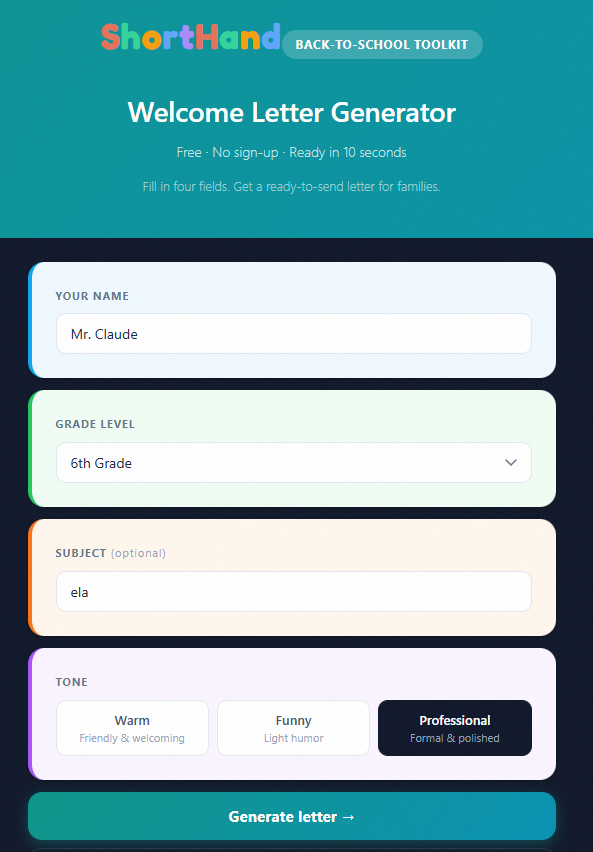
Tired of rewriting the same letter every August? The Welcome Letter Generator takes four inputs and returns a ready-to-send letter in about 30 seconds. Free, no sign-up.
Sample welcome letter template (fill in the blanks)
If you would rather write your own but want a starting structure, this is the skeleton all the examples above share. Copy it, fill in the brackets, and adapt it for elementary, middle, or high school.
Dear Families,
My name is [your name], and I am excited to be your child's [grade or subject] teacher this year at [school].
A little about me: [one or two human details. A hobby, a family fact, a favorite team. One is enough.]
What you can count on from me: [one honest sentence about what you care about as a teacher].
The best way to reach me is [app or email]. I reply within [your response window] on school days. For anything urgent, please contact the main office.
One favor: sometime this week, send me one sentence about your child. What they love, what worries them, anything you wish their teachers knew.
I cannot wait for this year.
Warmly, [Your name]
Every bracket is a decision the examples above can help you make. And if the personal-details bracket is where you freeze, that is normal. Pick the thing you would mention to another adult at a barbecue.
Example 4: My real first-year letter (and the resume mistake to avoid)
Here is a real welcome letter I sent during my first year. I am sharing it because I think the mistake I made is one a lot of teachers make, and it is easier to see in someone else's letter than your own.
Dear Family,
I am so excited to be teaching 3rd grade this year. I thought I would write this letter to introduce myself and tell you how to best get in touch with me.
My name is Greg Lebed. I spent 11 years as a one-to-one assistant for students on the autism spectrum. After that, I spent 10 years as a registered behavior therapist, where I would be assigned to different classrooms across South Jersey, helping students and teachers with very challenging behaviors. I would write behavior plans and work with students, parents, and teachers in implementing them. I also worked in some family's homes to teach children life skills and coping strategies. I have also been a substitute teacher at every grade level.
During the COVID shutdown, I decided to go back to school to become an elementary teacher. Last year I completed my student teaching in 3rd grade and was then asked to finish the year as a long-term substitute in 4th grade.
Although this will be my first year as a classroom teacher, I am certain my experiences have prepared me for what's to come.
Please let me know your preferred way to communicate. You may contact me through ParentSquare or my email.
Sincerely,
Greg Lebed
That letter is honest. It is warm in places. But look at where the word count goes: three full paragraphs about my background, one sentence asking how to communicate.
I spent about 70 percent of the letter talking about myself and 10 percent talking about what the family actually needed to know.
Here is what I would write today instead of that middle section:
Before becoming a classroom teacher, I spent more than 20 years working with students in schools and homes across South Jersey. Those years taught me a lot about behavior, communication, and what kids actually need. I am glad to finally have my own classroom.
Two sentences. Same information. Parents do not need the full timeline. They need to feel like you know what you are doing and that you care about their child.
The rest of the letter was fine. The mistake was the resume. Cut it down and the letter breathes.
Welcome Letter to Parents Checklist
Every welcome letter, regardless of grade or tone, should cover these five things:
- Your name and what you teach: sounds obvious, gets skipped more than you would think
- One personal detail: something that makes you a human being, not a job title
- What families can expect: communication style, your general approach, anything that answers "what kind of teacher are you"
- How to reach you: specific app or email, response time, what to do in an urgent situation
- An invitation: something that signals you actually want to hear from them, not just send information at them
Parents rarely remember every detail from a welcome letter. They remember how it made them feel. If families finish reading and think "my child is in good hands," the letter did its job.
Once the welcome letter is out the door, the next thing worth doing before September is building a documentation habit before you need one. The post on documenting student behavior from day one covers that exactly. And if you are teaching summer school and want to get your systems in place before the regular year starts, this piece on using ESY to build your documentation system is worth reading before August.
The welcome letter is also just the first entry in a year of parent communication. For everything that comes after it, from positive notes to the hard phone calls, the teacher's complete guide to parent communication is the map.
Gregory Lebed is a 3rd grade teacher with 20+ years of K-8 experience and a former Registered Behavior Technician. He built ShortHand to help teachers spend less time on paperwork and more time teaching.
Frequently Asked Questions
Stop trying to remember everything.
Try ShortHand Free →