Free Parent Teacher Conference Form (Printable Notes Sheet)
One page per student: what to fill in before, what to write down during, and what to do after.
Conference night moves fast.
You might have 15 minutes with one family, a few minutes before the next one arrives, if you're lucky, and a long line of names still waiting on your schedule. Somewhere around the third conference, a parent tells you something important. By the end of the night, you are trying to remember exactly who said what.
I remember how nervous I was for my first parent-teacher conferences during my first year. I didn't have any student work samples ready to show parents, and by the end of the night, I was even forgetting some of my students' names.
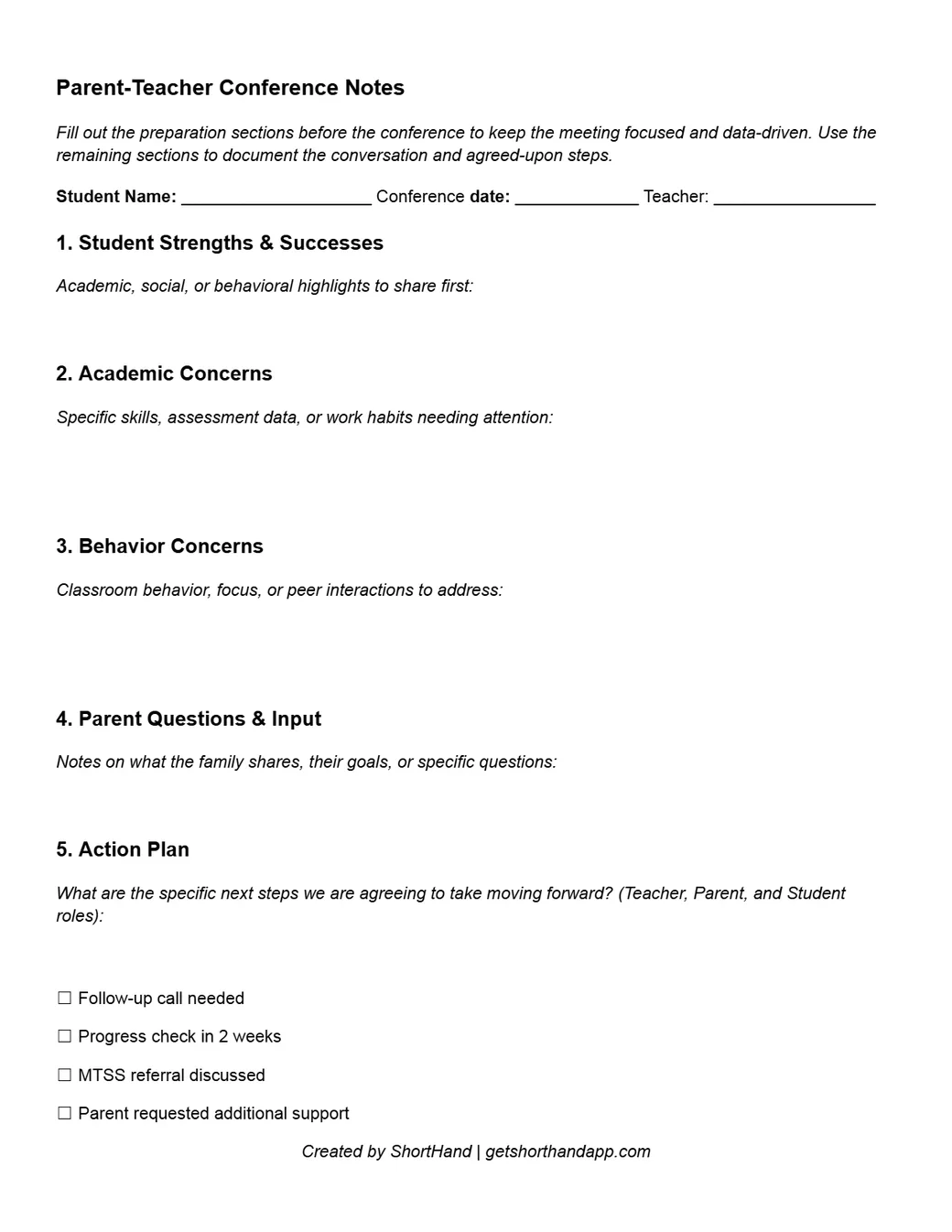
That is one reason I like having one simple parent teacher conference form for each student. Fill in the top sections before the meeting, use the bottom sections for your parent teacher conference notes during the conversation, then take one minute afterward to mark the follow-up. This one is free, printable, and does not require a sign-up.
Five sections in the order you use them: strengths, academic concerns, and behavior concerns before the meeting, then parent input and an action plan during it, with four follow-up checkboxes at the bottom.
Download the free conference form→One page per student, print and handwrite. No sign-up required.
What's on this parent teacher conference form
This template is one page per student on purpose. If you are preparing for 20 or 25 conferences, you do not need a packet for every child.
At the top are spaces for the student's name, conference date, and teacher. Then the form moves through five sections:
- Student Strengths & Successes
- Academic Concerns
- Behavior Concerns
- Parent Questions & Input
- Action Plan
The first three are meant to be filled in before the conference. Sections four and five give you space to document the conversation itself. At the bottom, four checkboxes help you flag anything that needs attention afterward.
It is a print-and-handwrite parent teacher conference sheet, not an editable or fillable digital form.
Before the conference: fill in sections 1 to 3
The best time to complete the first half of the form is before conference night, when you are not trying to remember everything with a parent sitting across from you. Give yourself three to five minutes per student and work from actual notes, work samples, or assessment data when possible.
If you need a broader conference-prep process, start with how to prepare for a parent teacher conference.
Student Strengths & Successes
Start with something real. "Sweet kid" or "doing great" may be true, but it does not tell a family much. Choose something you have actually observed.
For example:
"Reads aloud confidently during partner work and often helps explain directions to classmates."
That gives the parent something specific to picture. Starting with a strength also makes the rest of the conversation clearer because you are showing the family that you see the whole child, not just the skill or behavior you want to discuss.
If wording is the part that slows you down, these parent teacher conference comments can help you turn what you noticed into a clear sentence.
Academic Concerns
Keep this section narrow. You do not need to list every skill that could improve. Pick the one or two areas that matter most right now, then connect them to something concrete.
Instead of:
"Needs help with reading."
Try:
"Reads grade-level passages accurately but has difficulty answering questions that require evidence from the text."
Or:
"Solves addition facts accurately with counters but is not yet recalling them independently."
The goal is not to create a full academic report. It is to give the family a clear picture of the most important next step.
Behavior Concerns
Write what you can see, hear, count, or date. Avoid labels.
"Disrespectful" tells a parent how the behavior felt to you. It does not tell them what happened.
A more useful note would be:
"Talked over peers during partner reading 3 of 5 days last week. Stops after one reminder."
That gives you something concrete to discuss. If you are preparing for a conference where behavior is the main concern, see what to bring to a parent-teacher conference about behavior.
If there is no behavior concern, leave the box blank. You do not need to invent one just because there is space on the form.
My first year teaching, I had a challenging class and a lot of concerns about several students. Thankfully, my coworkers told me ahead of time to focus on the most important concerns instead of trying to cover everything. If you throw ten problems at a parent in 15 minutes, they can walk away feeling overwhelmed instead of knowing what actually matters most.
During the conference: write down what the family tells you
The part of conference notes that teachers sometimes skip is the part that can matter most later: what the family tells you.
Parent Questions & Input
You do not need a transcript. Write short notes that capture the important part of what the parent says.
That might include:
- a concern they have noticed at home
- a question you need to answer later
- tutoring or outside support
- a schedule change
- a new sibling
- sleep problems
- a goal the family has for the student
If a parent asks something you cannot answer in the moment, write the question down and give yourself a follow-up date. "Will check reading-group data and follow up by Friday" is much safer than trusting yourself to remember three days later.
Write only what you need in order to support the student.
Action Plan
The action plan is where the conference becomes useful after everyone leaves. Try to leave with one clear action for each person involved.
A vague plan sounds like:
"We'll keep an eye on it."
A specific plan sounds like:
"Teacher: Send a two-line update every Friday for three weeks."
"Parent: Sign the reading log each night."
"Student: Use the checklist taped to the desk before turning in work."
The exact actions will depend on the student, but they should be small enough that everyone understands what happens next. Before the parent stands up, read the plan back. That gives everyone a chance to correct something or ask a final question.
After the conference: the four checkboxes
The four boxes at the bottom are there so follow-up does not disappear into the rest of your week.
Follow-up call needed: Put a date on it.
Progress check in 2 weeks: Add it to your calendar that night.
MTSS referral discussed: Record only that it was discussed, then follow your school's normal MTSS process.
Parent requested additional support: Write down who owns the next step so the request does not become "someone should probably handle that."
Afterward, document the meeting as a parent contact using your school's normal system. If you need a simple process for that, see how to document parent contact as a teacher.
Keep the sheet somewhere you can find it again. It can be especially useful when spring conferences arrive and you want to look back at what everyone agreed to earlier in the year. At the end of the night, add any reminders or calendar entries you need so those follow-ups do not get lost.
I planned on following up with several families after my first round of parent-teacher conferences. For some of those tasks, I trusted my memory.
Not the best idea.
Questions to send home before conference night
You can also make the meeting easier by asking families for input ahead of time. A short note home a week before conferences could ask:
- What is going well with school at home?
- What is one question you want answered at the conference?
- Is there anything you would like me to know before we meet?
- Is there one area you would especially like us to talk about?
These questions are not printed on the PDF. They are just an optional way to collect information before the meeting. If families answer ahead of time, you can jot the important points in the Parent Questions & Input section before the conference even starts.
Looking for questions to ask during the conference itself? See questions to ask parents at a parent teacher conference.
When the paper form is not enough
The paper form works. The harder part is filling in those first three sections with useful information instead of trying to reconstruct the last six weeks from memory.
That is one reason I built ShortHand. It gives teachers a place to log quick student notes and parent communication during the school day while the details are still fresh.
If those notes already live in ShortHand, the Meeting Prep Report, included with Pro, can pull saved notes, parent contacts, goals, and accommodations into a meeting-ready PDF. It does not fill in this conference form for you. It simply gives you the documentation you already collected so you have something concrete to work from when it is time to prepare.
You can try ShortHand free.
Related reading: What to Say at a Parent Teacher Conference | How to Prepare for a Parent Teacher Conference | What to Bring to a Parent-Teacher Conference About Behavior
Part of The Teacher's Complete Guide to Parent Communication.
Frequently Asked Questions
Stop trying to remember everything.
Try ShortHand Free →