Missing Homework Email to Parents: 3 Copy-Paste Templates
Copy-paste email templates for a first missed assignment, a chronic pattern, or a student who has checked out.
It is 4:15 PM on a Thursday. You are sitting at your small kidney-shaped table with a cold cup of coffee and a stack of math packets. You flip to Leo's page and it is completely blank. Not even a name. You open your online gradebook and see this is the fourth missing assignment for him this two-week grading cycle. A heavy sigh escapes. You know you need to email his mom, but the thought of composing another email makes your eyes cross. You have to explain the situation, avoid sounding like you are accusing Leo of being lazy, and outline how they can fix it, all while hoping his mom does not write back a defensive page-long reply.
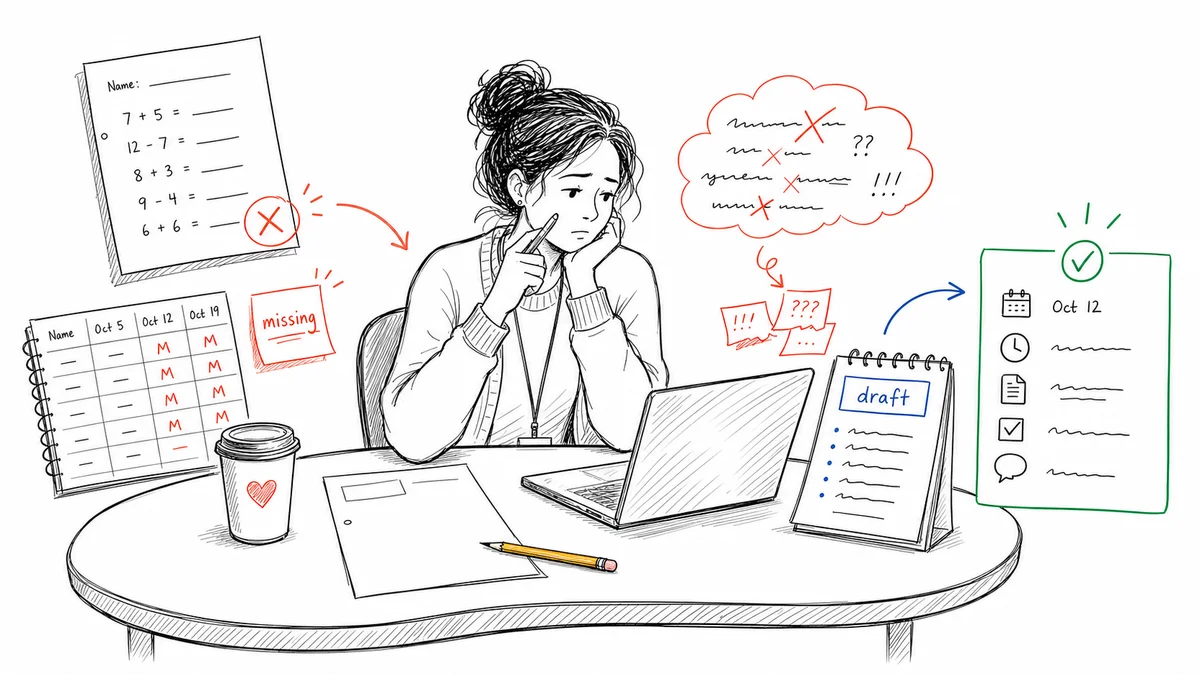
I have been there. In my years teaching third grade and working as a Registered Behavior Technician (RBT), I have written this exact parent email about missing assignments hundreds of times. In my early years, I either waited too long to reach out or sent emails that sounded too accusatory. Neither worked. When I used RBT principles of objective data and clear behavioral expectations, the responses changed. The parents stopped getting defensive and started helping.
If you are struggling with missing work in your classroom, you do not have to guess at what works. Below are three copy-paste email templates, one for the first missed assignment, one for a chronic pattern, and one for a student who has checked out completely, along with the strategy behind when to send each one.
The Mistake of the First Offense: When to Email
One of the biggest mistakes teachers make is emailing parents the very first time a student forgets to turn in a sheet of paper. We do it out of a desire to be proactive, but it backfires. If you email a parent for every single forgotten worksheet, two things happen. First, you will spend your entire planning period typing emails in Outlook. Second, the parent will quickly develop email fatigue. They will stop opening your messages because they feel like you are micromanaging their child.
On the flip side, waiting until report card season is a disaster. If a parent finds out their child has ten missing assignments only when they open the report card, they will be furious. And they have every right to be.
The sweet spot is the rule of three. If a student misses three homework assignments in a two-week period, or fails to turn in a major project by the due date, it is time to write an email. This rule of three demonstrates a developing pattern of behavior rather than a one-time slip. It gives the parent enough notice to help correct the course before the student's grade drops too far to recover. If the missing work is also accompanied by low assessment scores, you may be looking at an academic concern as well. That conversation requires a different approach, which you can read about in how to email parents about academic concerns.
Objective Language: The Former RBT Approach
When you write an email to parents about missing homework, your tone must be objective, neutral, and collaborative. As a former RBT, I was trained to describe behavior in ways that are observable and measurable. When we write to parents, we must apply this same rule.
Avoid subjective descriptions. Do not write that Leo is lazy, unmotivated, or choosing to ignore his work. These words trigger defensiveness. A parent who reads that their child is lazy will immediately think of all the times their child worked hard at home, and they will write back to defend them.
Instead, stick to the data. State that Leo has three missing math assignments from this week. Frame the email as a partnership. You and the parent are a team working to support the child. You are not a judge handing down a sentence. If you need tips on formatting other types of communications, you can read about how to write behavior emails to parents to see how keeping your descriptions strictly factual keeps the peace.
Four Elements Every Missing Work Email Needs
To make the email effective, you must include four specific pieces of information:
- The exact names and dates of the missing assignments. Vague statements like "Leo is missing some work" lead to back-and-forth emails asking for details.
- The current impact on their grade. Parents need to understand the stakes.
- The absolute deadline for turning in the work. Be clear about whether you accept late work for full credit, partial credit, or no credit.
- A concrete action step. Tell the parent exactly what they need to do tonight to help.
Keep track of every email in your free parent communication log for teachers so you have a clear contact history. That record matters if you need to escalate the issue later.
3 Copy-Paste Templates for Missing Homework
Here are three templates you can use depending on the situation:
Template 1: The First Slippage (3 missing assignments, or first minor pattern)
Subject: Missing homework assignments: Leo
Hi [Parent Name],
I hope your week is going well. I am reaching out to share a quick update about Leo's math homework.
Leo has been doing a great job participating in our daily math discussions. However, he is currently missing three homework assignments from this week: the double-digit subtraction worksheet from Monday, the word problems page from Tuesday, and the rounding practice from Thursday.
These missing assignments have dropped his overall math grade to a C. He can still submit these assignments for full credit if he turns them in by next Friday, October 12th.
Could you please check Leo's backpack tonight to help him locate these pages? I want to make sure he gets these turned in so his grade reflects his actual math skills.
Thank you for your support,
[Your Name]
Template 2: The Established Habit (long-term missing work, impacting the grade severely)
Subject: Action needed: Chronic missing work for [Student Name]
Hi [Parent Name],
I am writing to check in regarding [Student Name]'s missing assignments in reading and social studies.
We have discussed the importance of turning in homework during class, but we are seeing a consistent pattern of incomplete work. [Student Name] currently has six missing assignments from the past two weeks. I have listed them below:
- Main Idea worksheet (due 10/1)
- Character traits chart (due 10/3)
- Explorer map project (due 10/5)
- [List other assignments here]
Because of these missing tasks, [Student Name]'s grade is currently a D. I accept late work for a maximum grade of 70% up until five school days after the original due date.
To help [Student Name] get back on track, I suggest setting up a specific 15-minute homework time at home each night. I will also have [Student Name] write their assignments in their planner daily, which I will initial. Could you please check and sign the planner each evening?
Let me know if you would like to hop on a quick call to coordinate this support.
Best,
[Your Name]
If the pattern escalates and you end up needing a face-to-face meeting, how to prepare for a parent-teacher conference walks through how to bring your documentation into that room without the meeting going sideways.
Template 3: The Completely Checked Out Student (shutting down in class, missing everything)
Subject: Academic concern: [Student Name]'s progress and missing work
Hi [Parent Name],
I am reaching out because I am concerned about [Student Name]'s academic progress and overall engagement in our classroom.
Recently, [Student Name] has been struggling to complete both in-class tasks and homework assignments. When it is time for independent work, [Student Name] often puts their head on their desk or leaves their papers blank. Currently, they have ten missing assignments, and their grade has fallen to an F.
Here are the key assignments that are missing:
- [List major missing assignments here]
My main concern is not just the grade, but that [Student Name] is missing foundational skills they need for the next unit. I want to help them catch up, but we need a clear plan.
I would like to set up a brief phone call or a meeting this week to discuss how we can support [Student Name] together. Please let me know what day and time works best for you.
Sincerely,
[Your Name]
Once you send that first email, document it. Add it to a free parent communication log with the date, the student's name, and what you sent. If the missing work pattern continues and you end up in a parent meeting or an IEP conversation, that log is evidence that you reached out early and often. For a broader set of email templates covering more than just missing work, the free parent email templates for teachers page has copy-paste options for behavior, progress updates, and conference requests.
Frequently Asked Questions
Stop trying to remember everything.
Try ShortHand Free →