How to Email Parents About Academic Concerns (Without Making Them Defensive)
Frame school struggles as a team effort using data-backed parent communication strategies.
You are looking at the math intervention tracker at 4:30 PM on a Tuesday. The spreadsheet is color-coded, and Mia's row is a sea of red. She has scored below the benchmark on the last four multiplication quick checks. You know she is trying. She sits at her desk, she bites her lip, and she scribbles numbers, but she is falling further behind every day. You know you need to reach out to her parents. But academic concerns are a minefield. If you phrase it poorly, parents might feel attacked, think you are calling their child dumb, or assume you are not doing your job.
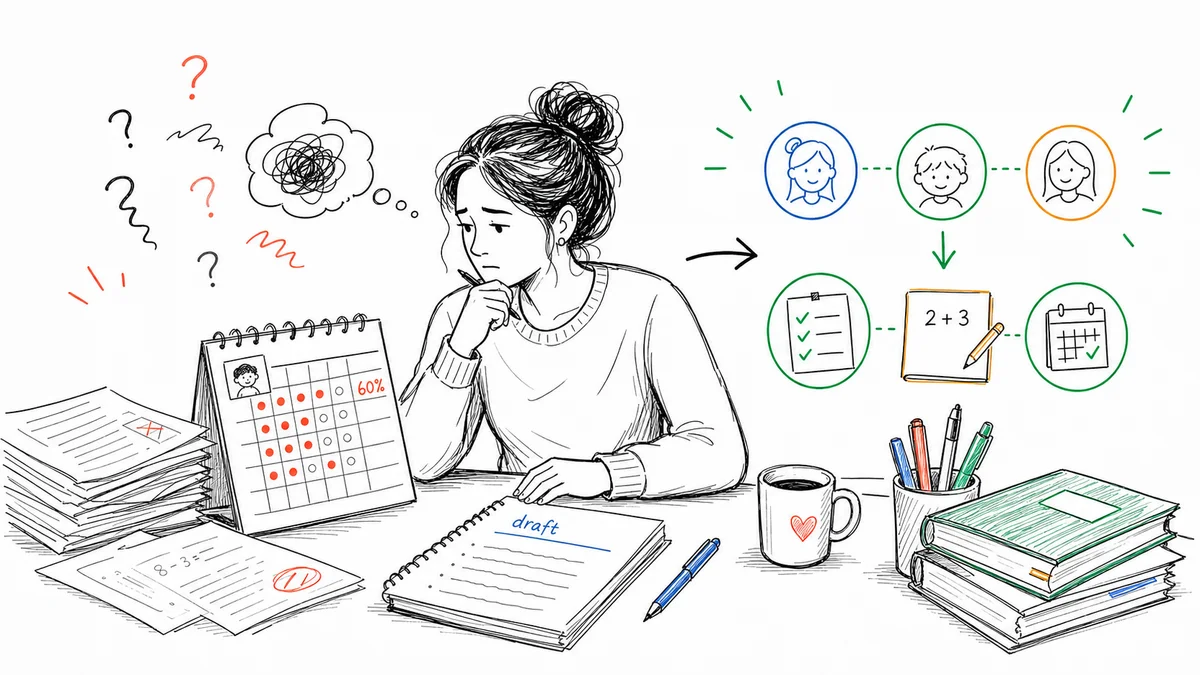
As a teacher and former RBT, I know that sharing academic struggles requires a specific strategy. You must frame the conversation as a team challenge, back it up with objective data, and present a clear path forward. Here is how to navigate this conversation without causing defensiveness.
Shift the Frame: From Blame to Teamwork
The biggest mistake you can make when emailing parents about academic concerns is presenting the issue as a failure on the part of the student or the family. If you write, "Mia is struggling because she does not practice at home," or "Mia is failing math because she does not pay attention," the parent will immediately go on the defensive.
Instead, position yourself and the parent on the same side of the table, looking at the problem together. Use collaborative language. Say, "I want to share some observations so we can support Mia together." Frame the struggle as a skill gap, not a character flaw. This approach lowers the parent's guard and invites them to collaborate with you.
When you frame it this way, you make the parent feel like an essential partner in their child's education. If you are also dealing with behavioral challenges alongside the academic ones, you might want to look at sample emails to parents about student behavior to see how to maintain a collaborative tone across different issues.
Use Objective Data, Not Impressions
Do not rely on vague observations. Saying "Mia seems lost during math" or "Mia is struggling with reading" is not helpful. It leaves too much room for interpretation and makes it look like you are acting on a hunch.
Instead, bring the data. Mention specific assessments, work samples, and classroom benchmarks. For example, write, "On our weekly multiplication check, Mia scored 2 out of 10. The grade-level goal is 8 out of 10." State the facts of what you have observed in class, such as, "During independent writing, Mia is able to write one sentence in ten minutes, whereas the expectation is a short paragraph."
This objective description makes the problem concrete and much harder to wave away. When academics and classroom behavior intersect, the same data-first approach applies to how to write behavior emails to parents. When you share data, you show parents that your concern is based on evidence, not a subjective opinion.
Invite Parents in with Actionable Steps
When you ask parents to help at home, make sure you are not making them feel like they are failing to parent. Do not demand that they tutor their child for an hour every night. A lot of parents are exhausted by the time homework happens, and most are not trained educators.
Instead, give them micro-tasks that are easy to integrate into their existing routines. Ask them to do five minutes of flashcards in the car, or have their child read aloud while they make dinner. Make the request specific, simple, and manageable. When parents see a clear, simple task, they are much more likely to actually do it. If missing homework is part of the academic picture, you may also want to send a separate email about missing assignments that covers the work gap specifically, so the academic concern email stays focused on skills rather than habits.
2 Copy-Paste Academic Concern Templates
Here are two templates you can use depending on the severity of the concern:
Template 1: Early academic concern (proactive outreach)
Subject: Sharing a quick update on Mia's reading progress
Hi [Parent Name],
I hope you are having a great week. I wanted to reach out and share a quick update on Mia's progress in reading.
Mia is such a hard worker, and I love how she always volunteers to help hand out materials in class. Recently, I have noticed that she is finding our reading comprehension activities a bit challenging.
On our last three weekly reading checks, Mia scored an average of 60%. The grade-level goal is 80%. Specifically, she is finding it hard to identify the main idea of a story.
I want to make sure we catch this early so she feels confident. In class, I am working with Mia in a small group three times a week to practice finding key details.
At home, could you please have Mia tell you one key detail from the book she reads with you each night? This quick conversation will help reinforce what we are doing in class.
I will check in again in two weeks to let you know how she is progressing.
Best,
[Your Name]
Template 2: Significant academic concern (meeting request)
Subject: Meeting request: Academic support plan for [Student Name]
Hi [Parent Name],
I am reaching out to discuss [Student Name]'s academic progress in math and to schedule a time for us to meet.
[Student Name] has shown great effort in class, but they are currently performing significantly below grade level in math. On our unit assessments for fractions, [Student Name] scored a 45%, and they are struggling to complete grade-level tasks independently.
I want to ensure [Student Name] has the support they need to be successful. I would like to schedule a 15-minute meeting this week so we can look at some of their work samples together and create a collaborative support plan. If you want to read more about what to actually say once you are in that meeting, what to say at a parent-teacher conference covers how to present concerns and next steps without the conversation going off the rails.
Here are a few times I am available:
- Tuesday after school (3:30 PM - 4:15 PM)
- Thursday morning (8:00 AM - 8:30 AM)
- Friday afternoon (3:30 PM - 4:00 PM)
Please let me know if one of these options works for you, or if you prefer a phone call.
Thank you for your partnership,
[Your Name]
If the first email leads to a meeting request, use how to prepare for a parent-teacher conference to walk into that room with your data organized and a plan in hand. And start logging every email you send in a parent communication log. If the concern escalates to an IEP conversation or a difficult phone call, that documentation record is what shows the school you flagged the issue early and communicated consistently.
Frequently Asked Questions
Stop trying to remember everything.
Try ShortHand Free →