How to Document Tier 2 Interventions for MTSS Without Creating More Paperwork
If you have ever sat in an MTSS meeting thinking, "I know I've been doing interventions, but I don't have the data to prove it," you're not alone.
Most teachers are not struggling to provide interventions.
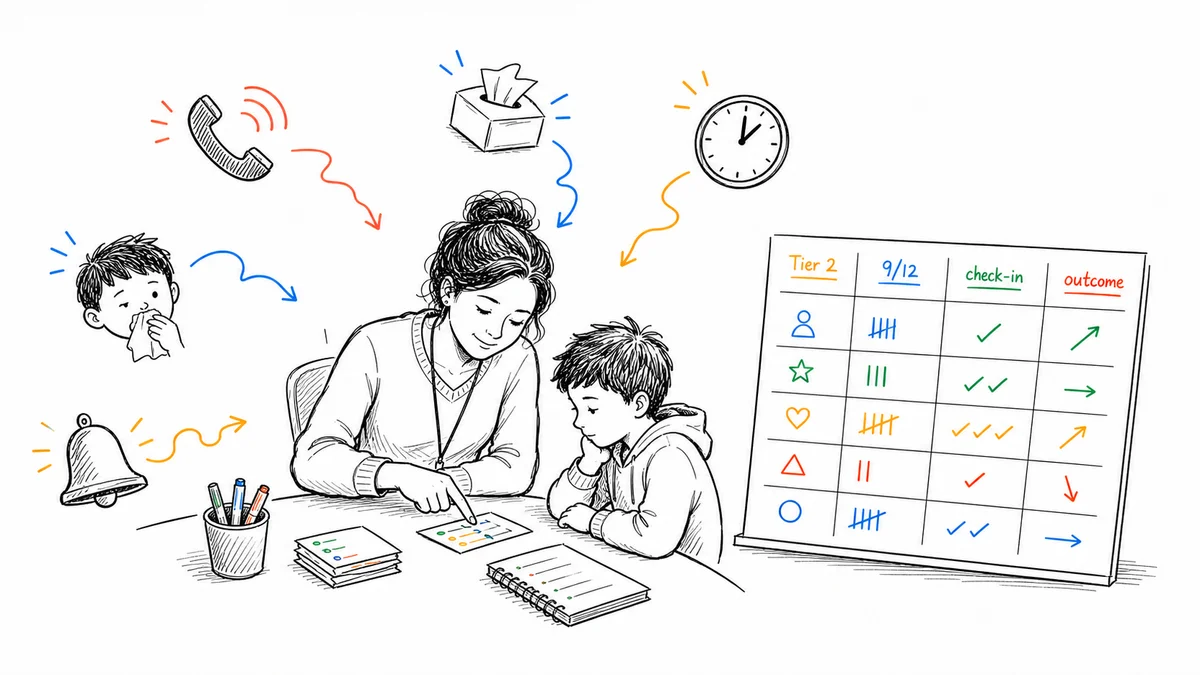
They're struggling to document them consistently. You may have started to log an intervention, but then Mary had a nosebleed, Johnny lost his tooth, and Jacob finally learned why we don't lean back in our chairs.
The challenge is not knowing what to do. The challenge is finding time and energy to record what happened while managing a classroom full of students.
What Is a Tier 2 Intervention?
Tier 2 interventions are targeted supports for students who need more help than the core instruction provided to the entire class.
Examples include:
- Check-in/check-out systems
- Small group behavior support
- Social skills groups
- Daily behavior goals
- Academic intervention groups
- Additional progress monitoring
Unlike Tier 1 supports, Tier 2 interventions require documentation. If a student's behavior is significant enough that the team is considering a formal plan, see the Behavior Intervention Plan Template for what that next step looks like in writing.
When a team asks whether an intervention is working, opinions are not enough. They need data.
The Documentation Problem
Most teachers start with good intentions. You tell yourself you'll write notes at the end of the day. Then the dismissal bell rings. A parent calls. A meeting starts. You cover another class. By the time you finally sit down, the details are fuzzy.
You remember that something happened.
You don't remember exactly what happened.
That is how documentation systems slowly fall apart.
What Data Should You Collect?
You do not need a novel.
For most Tier 2 interventions, focus on:
Frequency
How often did the target behavior occur?
Examples:
- Out of seat behavior: 6 times
- Calling out: 4 times
- Work refusal: 2 incidents
Duration
How long did the behavior last?
Examples:
- Off-task for 15 minutes
- Needed 5 minutes to calm down
Intervention Used
Document what support was provided.
Examples:
- Visual reminder
- Check-in with teacher
- Break card
- Small group reteaching
Student Response
Did the intervention help?
Examples:
- Returned to work after reminder
- Completed assignment with support
- Continued refusing task
For a deeper look at building a consistent tracking habit around this data, How to Track Student Behavior Data covers the practical steps.
Tier 2 Intervention Examples (and What to Document for Each)
The four data points above become much easier to use when you connect them to the intervention you are actually running. The team may decide which Tier 2 support a student receives, but your notes are what help everyone see whether that support is working.
Academic Tier 2 Interventions
Small-group reteaching. A few students who missed the same skill get another chance to learn it in a smaller group, with the lesson narrowed down to that specific skill.
What to document: the skill taught, the date and duration of the group, the number of students, and the student's response on a quick check, such as 4 of 5 two-digit subtraction problems correct.
Repeated reading for fluency. The student reads the same short passage several times and gets feedback between attempts.
What to document: the passage level, words correct per minute on a short timed read, and the number of sessions completed.
Phonics or decoding practice. The student gets extra practice with one specific sound or spelling pattern, such as short vowels or one vowel team.
What to document: the pattern practiced and the student's accuracy on a short word list, such as 7 of 10 vowel-team words read correctly.
Math fact fluency practice. The student works on one set of facts in short practice sessions.
What to document: the fact set, the number answered correctly on a short timed check, and the trend from week to week.
Pre-teaching. Before the whole-class lesson, the student gets a quick introduction to the vocabulary, steps, or ideas that are likely to cause trouble. This gives the student something familiar to connect to during the full lesson.
What to document: the lesson, what was pre-taught, and the student's response during the whole-class lesson, such as whether they used the vocabulary or participated successfully.
Targeted writing practice. You pick one writing skill, such as writing complete sentences or adding details, and practice only that.
What to document: the skill practiced and a count from a short writing sample, such as 3 complete sentences out of 5.
Behavior Tier 2 Interventions
Check-in/check-out (CICO). The student checks in with an adult at the beginning of the day, carries a point card that teachers rate during the day, and checks out again before leaving.
What to document: whether check-in and check-out happened, the percentage of points earned, and whether the daily goal was met.
Daily behavior goal. The student works on one or two clearly stated goals that are rated at set points during the day. Keeping the goal narrow makes the data much easier to understand later.
What to document: the exact goal wording, the rating for each time block, and the number of days the goal was met out of the days tracked.
Social skills group. A small group practices one specific skill, such as joining a game, taking turns, or handling a disagreement. The important part is watching for whether the skill starts showing up outside the group.
What to document: the skill taught, the sessions attended, and how often you saw the student use the skill in class, at lunch, or at recess.
Self-monitoring checklist. At set times, the student quickly rates their own behavior while the teacher records a rating too. For example, the student might answer, "Was I working?" at the end of each work period.
What to document: the student's rating next to the teacher's rating and the frequency of the target behavior during the same period.
Break card. The student has a clear way to request a short break instead of walking away from the task or stopping work without communicating.
What to document: the number of breaks requested, the duration of each break, and whether the student returned to the task afterward and how long that took.
Adult mentor check-ins. A staff member meets briefly with the student on a regular schedule to review how things are going and reinforce the same expectations.
What to document: the dates the check-ins occurred and a weekly frequency count of the target behavior so the team can see whether it is changing.
You do not need Frequency, Duration, Intervention Used, and Student Response for every intervention. Choose the one or two measures that best answer "Is this working?" and record them consistently.
Keep Notes Objective
Avoid:
Student was disrespectful and difficult all morning.
Instead write:
Student left seat three times during independent work and refused two teacher requests to return.
The second example is more useful because another person can clearly picture what happened. Objective notes help teams identify patterns.
A Simple MTSS Documentation System
You do not need a complicated spreadsheet with 25 columns.
Many teachers succeed with a simple format:
Date
Target Behavior
Intervention Used
Outcome
For example:
September 12
Work refusal during math
Provided teacher check-in and visual checklist
Completed 7 of 10 problems after support
Need a printable version?
Download the free MTSS Tier 2 Intervention Tracking Sheet to record the date, target behavior, intervention used, and student response during a 6-8 week intervention cycle.
That takes less than a minute to record and gives your team something meaningful to review later. You can start with the free teacher documentation log template and adapt the columns to match your intervention data.
What Happens When Documentation Is Consistent?
Consistent documentation helps answer important questions:
- Is the intervention working?
- Is the behavior improving?
- Does the student need a different support?
- Should the team consider Tier 3 interventions?
Without documentation, those conversations become guesswork. With documentation, teams can make decisions based on patterns instead of memories. If the data eventually points toward a referral or formal evaluation, see How to Document Student Behavior for IEP Meetings for how to organize what you have collected.
Once a few weeks of these notes are logged, that history becomes something you can actually use instead of re-reading every entry before a team meeting. Ask ShortHand can help you find out something like, "how has work refusal during math changed this month?" and it pulls the answer directly from what you documented. It only knows what you logged, so the documentation habit above is still what makes this useful.
If you're weighing ShortHand against other options for this, special education behavior tracking software compares it against tools built for more formal IEP goal data collection.
Final Thoughts
Most MTSS problems are not intervention problems. They are documentation problems. Teachers are already doing the hard work. The challenge is capturing enough information to show what happened.
A simple system that allows you to record observations in the moment will always be more effective than a perfect system that depends on your memory hours later.
If your current system depends on remembering everything at the end of the day, you are not alone. Most teachers are doing the best they can with sticky notes, notebooks, and memory. ShortHand was built to make that process easier. Try it free at getshorthandapp.com
Related reading:
- The Only Teacher Documentation Log Template You Actually Need
- Behavior Intervention Plan Template
- How to Document Student Behavior for IEP Meetings
- How to Track Student Behavior Data
- IEP Meeting Checklist for Teachers
- IEP Meeting Notes Template for Teachers
Part of The Teacher's Complete Guide to Documenting Student Behavior.
Frequently Asked Questions
Stop trying to remember everything.
Try ShortHand Free →